Every card payment helps revenue move faster, but it also takes a bite out of every sale. For many merchants, that bite is much larger than it should be. The problem is not just interchange fees or processor markup.
It is a mix of pricing confusion, avoidable transaction mistakes, hidden monthly charges, weak contract oversight, and payment tools that do not match how the business actually gets paid.
If you want to Reduce Your Credit Card Merchant Fees, the goal is not to slash costs blindly. It is to lower expenses in ways that protect conversion rates, keep checkout smooth, and support daily operations.
Done right, you can Reduce Credit Card Processing Fees, improve margin, and make your payment setup work harder for the business rather than against it.
Many owners focus only on the advertised rate. That is where overpaying usually begins. The real story lives in the effective rate, statement detail, card mix, chargeback activity, keyed-in volume, gateway costs, PCI compliance fees, and whether your pricing model is helping or hurting you. A small markup issue multiplied across months of volume can quietly turn into a major profit leak.
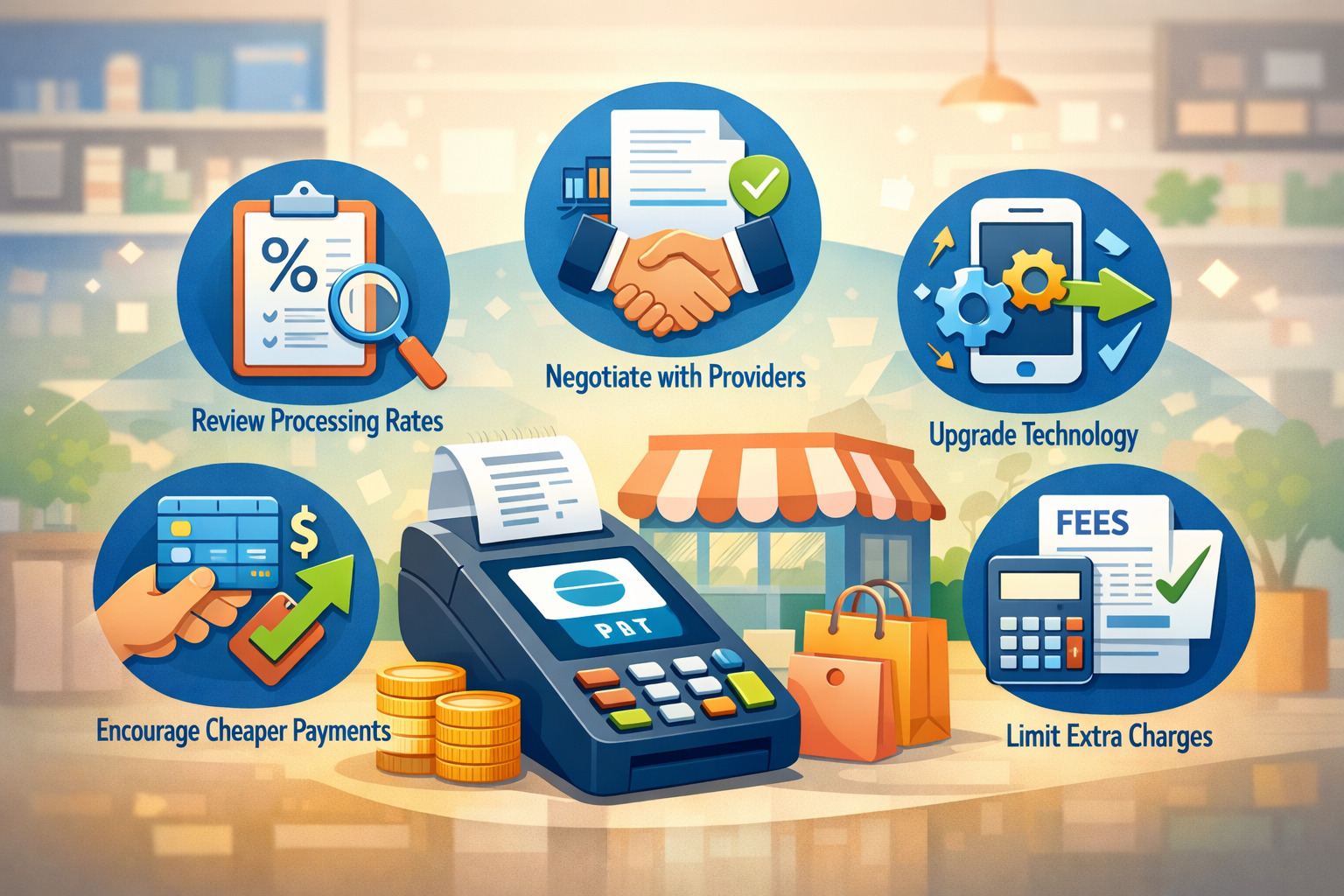
This guide breaks down five practical ways to Lower Credit Card Merchant Fees without creating checkout friction or reducing service quality.
You will learn how to review your statements, compare pricing models, negotiate smarter, reduce avoidable transaction costs, and choose a payment setup that fits your sales channels. Along the way, you will also see where merchants commonly lose money and how to correct it with simple, practical changes.
What It Really Means to Reduce Your Credit Card Merchant Fees
To Reduce Your Credit Card Merchant Fees, you do not need to stop accepting cards or push customers into inconvenient payment options. You need to understand what you are paying for, which fees are fixed by the card ecosystem, which fees are negotiable, and which costs show up because of preventable issues inside your payment flow.
At a basic level, credit card processing fees usually include three layers:
- Interchange fees tied to the transaction type
- Network-related assessments or pass-through costs
- Processor markup and account-related fees
The confusing part is that many statements blend these together in ways that make comparison difficult. A merchant may think the rate looks acceptable, while monthly minimums, PCI compliance fees, gateway fees, batch fees, chargeback fees, and higher-cost transaction types quietly raise the actual expense. That is why reducing fees is not just about asking for a lower rate. It is about reducing the total cost of acceptance.
Another important point is that not all businesses lose money in the same places. A retail store may overpay because of a bad pricing model. An eCommerce brand may overpay because fraud controls are weak and too many transactions fall into higher-risk categories.
A service business may overpay because staff key in cards manually instead of using invoices, card-on-file tools, or mobile readers. A subscription business may leak margin through avoidable chargebacks and poor recurring billing setup.
Why So Many Businesses Overpay Without Realizing It

Most merchants do not wake up one day and decide to overpay for processing. It happens slowly. A provider offers fast onboarding, the rate looks simple enough, the terminal works, and the statements keep getting filed away without a close review. Over time, the account collects small charges, pricing changes, extra tools, and contract terms that no longer make sense for the business.
One of the biggest reasons businesses overpay is that payment processing statements are hard to read. They may be packed with abbreviations, fee categories, bundled costs, and vague labels that make it difficult to tell what is normal and what is not.
That confusion benefits providers with opaque pricing. It also keeps merchants from seeing whether their payment mix has changed in a way that makes the current plan more expensive than necessary.
Another common issue is that businesses focus only on the headline rate. A processor may advertise a low percentage while making money elsewhere through:
- Nonqualified or downgraded transaction pricing
- Monthly service fees
- PCI compliance fees
- Gateway and reporting fees
- Annual or account maintenance charges
- Statement fees
- Monthly minimums
- Early termination penalties
- Excessive per-transaction charges
The result is a merchant account that looks affordable at first glance but costs much more in practice. This is especially common with tiered pricing, bundled plans, or contracts that leave room for markup changes and fee additions.
Businesses also overpay when payment tools do not match the sales model. A company that takes a lot of remote payments but relies on keyed-in transactions may face higher transaction costs than one using secure invoices, tokenized card-on-file billing, or hosted checkout tools.
A multi-channel merchant may be paying for duplicated systems instead of using one setup that supports in-person, online, and recurring transactions efficiently.
For a broader look at how these quiet expenses build up, Understanding the True Cost of Accepting Cards highlights how visible and hidden costs can change your real effective rate. The core lesson is simple: you cannot fix what you have not measured.
Way 1: Review Your Merchant Statement Like a Cost-Control Tool
The fastest way to Reduce Credit Card Processing Fees is often to start with the statement you already have. Many businesses try to shop rates before they understand their current costs.
That approach makes it easy to miss real savings opportunities, because the biggest problems may not be the advertised rate at all. They may be buried in line-item fees, unnecessary services, or transaction patterns that are pushing costs higher month after month.
A statement review turns vague frustration into concrete action. It shows where your money is going, what part of the cost may be negotiable, and which issues come from operational habits rather than the processor itself. It also gives you real leverage if you decide to negotiate or compare providers.
When reviewing your statement, look beyond the summary page. Go line by line and identify every recurring fee, every markup-related charge, and any categories that seem unclear or duplicated. Compare at least several statements, not just one, because some charges appear irregularly or get added later.
What to Look for in a Merchant Statement
A useful merchant statement review starts with separating unavoidable costs from avoidable ones. Interchange and network-related costs are part of card acceptance. Processor markup, pricing structure, and many account fees are where you may find room to save.
Pay close attention to these items:
- Effective rate for the month
- Processor markup
- Per-transaction fees
- Batch fees
- PCI compliance fees
- Gateway fees
- Statement or account fees
- Monthly minimums
- Chargeback fees
- AVS or verification fees
- Fees tied to nonqualified or downgraded transactions
If you are on a tiered plan, the statement may not clearly show how much of your volume is falling into expensive buckets. That makes it harder to see why costs are high.
If you are on interchange-plus pricing, the statement is often easier to audit because pass-through costs and markup are separated more clearly. That transparency matters when you want to compare offers or challenge unnecessary charges.
You should also look for patterns. Did your effective rate jump during a month when keyed-in volume increased? Did a new monthly fee appear after a software change? Are you paying for a gateway feature you do not use? Small details like these can reveal where you can Save on Merchant Account Fees without changing customer experience.
Common Hidden Processing Fees That Inflate Your Costs
Hidden processing fees are not always truly hidden. They are often just buried under labels that merchants do not have time to decode. That is why they survive for months or even longer. Some fees are standard in certain setups, but still worth questioning if they do not match the value being delivered.
Common examples include:
- Duplicate monthly service charges
- Gateway fees layered on top of bundled software fees
- PCI compliance charges that continue even when another vendor handles compliance tools
- Monthly minimums that no longer fit your volume
- Excessive batch fees due to how transactions are settled
- Reporting or portal fees for tools no one uses
- Annual account fees with little explanation
- Added fees after a contract renewal or pricing update
Chargeback-related costs also deserve attention. The fee for a dispute is only part of the expense. Lost revenue, staff time, and higher-risk pricing can raise total payment processing costs further. If a statement shows rising disputes, you may need to address the root cause rather than just absorb the fee.
Merchants often discover that their processor is not overcharging in one dramatic way. Instead, several small costs combine into a meaningful drag on profit. Once you identify them, you can often remove or reduce them through negotiation, account restructuring, or a provider comparison.
For a deeper look at fee structures and how they affect transparency, the guide to Merchant Services Pricing Models is a helpful background when you are trying to make sense of the numbers.
Way 2: Choose the Right Pricing Model Instead of Chasing the Lowest Advertised Rate
One of the most effective ways to Lower Credit Card Merchant Fees is to make sure your pricing model fits your business. Many merchants stay on the first plan they were given.
Others switch providers based on a headline rate that sounds attractive but does not reflect the full cost of their transaction mix. That is how businesses end up paying more while thinking they found a better deal.
The three models most merchants run into are flat-rate pricing, tiered pricing, and interchange-plus pricing. Each can serve a purpose, but they are not equally transparent. They also do not work equally well for every business type.
The right choice depends on your average ticket, monthly volume, sales channels, card-present versus card-not-present share, and how much detail you need to manage costs.
A small business with unpredictable volume may value simplicity more than deep fee optimization at first. A growing retailer or multi-channel merchant usually benefits from clearer pricing transparency.
A service business that runs invoices, card-on-file payments, and occasional in-person transactions may need a setup that balances convenience with lower transaction costs.
The point is not to declare one model universally perfect. It is to choose the model that gives you the best visibility and the fairest economics for how you actually get paid.
Interchange-Plus, Flat-Rate, and Tiered Pricing Compared
Here is a simple comparison of common merchant services pricing models and how they affect cost control:
| Pricing Model | How It Works | Best Fit | Main Advantage | Main Risk |
| Interchange-Plus Pricing | You pay actual interchange and assessments plus a clearly stated processor markup | Established merchants, growing businesses, merchants who want transparency | Easier to audit and negotiate | Can look more complex on the statement |
| Flat-Rate Pricing | One bundled rate for most transactions | Lower volume merchants or businesses that want simplicity | Easy to predict | Can become expensive as volume grows |
| Tiered Pricing | Transactions are grouped into pricing tiers like qualified, mid-qualified, and non-qualified | Rarely ideal unless the structure is unusually clear | Familiar to some merchants | Often the least transparent and hardest to compare |
Interchange-plus pricing is often attractive because it separates the negotiable part of the cost from the non-negotiable pass-through part. That makes it easier to understand processor markup and evaluate competing offers.
Understanding Interchange Plus Pricing and Why It Matters for Merchant Accounts explains why this model is commonly associated with pricing transparency and better line-of-sight into real costs.
Flat-rate pricing can still work well in some cases. It offers convenience, quick setup, and simpler statements. But many businesses outgrow it. As sales increase, the convenience premium can quietly become expensive.
Tiered pricing tends to create the most confusion because merchants may not know in advance which transactions will fall into higher-cost buckets.
How to Match the Pricing Model to Your Sales Mix
The best pricing model is the one that fits your transaction behavior, not the one with the best marketing. Start by asking a few practical questions:
- What share of your volume is in-person versus online?
- How many transactions are manually keyed?
- Do you run recurring billing or card-on-file payments?
- Is your monthly volume stable or unpredictable?
- Do you need deeper reporting to control costs?
Retail businesses that accept a lot of tap, chip, or dip transactions often want a structure that rewards better transaction quality. eCommerce merchants care more about fraud controls, gateway costs, and card-not-present pricing.
Service businesses may need invoice tools, mobile acceptance, and secure card-on-file workflows to avoid expensive manual entry. Multi-channel merchants need a setup that prevents duplicate systems, duplicate fees, and operational gaps between online and in-person sales.
A provider that fits your model may save more than a lower advertised rate from a provider that does not. That is why pricing transparency matters so much. You want to see the true cost of acceptance, compare it fairly, and understand how your business can improve its own fee outcomes.
Way 3: Negotiate Processor Markup, Contract Terms, and Junk Fees
Many merchants assume processing terms are set in stone. They are not. Interchange costs may be largely fixed, but processor markup, account fees, equipment terms, software charges, and contract language can often be negotiated.
This is one of the most overlooked ways to Reduce Merchant Processing Costs, especially for established businesses with stable volume and a decent processing history.
The key is to negotiate with evidence. Providers are much more likely to respond when you can show your monthly volume, effective rate, chargeback ratio, average ticket, and current fee structure.
A merchant who understands their statement is in a much better position than one who asks vaguely for “better rates.” Specific requests create leverage.
Negotiation is not only about lowering the percentage markup. Sometimes the biggest win comes from removing monthly minimums, cutting statement fees, waiving PCI compliance charges, reducing per-item fees, or simplifying gateway costs.
Contract flexibility also matters. A slightly lower rate is less valuable if the agreement locks you into poor service or makes it painful to leave later.
If your business has grown since the account was opened, that alone may justify a pricing review. Processors often keep merchants on outdated terms until the merchant asks questions. That means loyalty can become expensive when it is not backed by regular review.
What You Can Negotiate and What You Usually Cannot
A productive negotiation starts by knowing where flexibility exists. In most cases, the processor cannot eliminate the underlying interchange structure. What they can usually control is their own markup and many of the account-level fees layered around it.
You may be able to negotiate:
- Processor markup
- Per-transaction fees
- Monthly account fees
- PCI compliance fees
- Gateway fees
- Batch fees
- Monthly minimums
- Early termination language
- Equipment lease or replacement terms
- Reporting or support charges
- Volume-based pricing adjustments
You usually have less room to change pure pass-through costs tied to the card ecosystem. That is why understanding the difference between pass-through and markup matters. Once you separate those pieces, the negotiation becomes more realistic and more effective.
You should also ask how pricing changes are handled over time. Can the provider raise markup with notice? Are there vague clauses that allow fee changes without a meaningful review? What happens if your volume grows or your channel mix changes?
Contract terms matter because they affect not only what you pay now, but what you may be paying later if the account drifts out of alignment with your business.
How to Compare Providers Without Falling for Headline Rates
Provider comparison goes wrong when merchants compare marketing pages instead of real cost structures. A provider may promise a low rate that excludes gateway fees, software fees, compliance costs, monthly charges, or card-not-present realities. Another provider may quote a slightly higher markup but offer a cleaner total cost and better-fit tools.
When comparing providers, request a side-by-side breakdown that includes:
- Pricing model
- Markup structure
- Per-transaction charges
- Monthly fixed fees
- Gateway and software fees
- PCI compliance fees
- Batch fees
- Chargeback fees
- Contract length and exit terms
- Support and reporting tools included
Then compare based on projected effective rate, not just the top-line percentage. This is how you Cut Credit Card Processing Fees in a way that lasts. You are not just shopping for a lower number. You are shopping for a better operating model.
For merchants evaluating offers, How to Get the Lowest Credit Card Processing Fees reinforces the importance of looking past headline pricing and understanding how markups and downgrades shape the real cost of card acceptance.
Way 4: Reduce Avoidable Transaction Costs, Downgrades, and Chargebacks
A large share of payment processing waste does not come from the processor alone. It comes from how transactions are accepted, stored, verified, and managed. Merchants often focus on rates while overlooking the daily habits that push costs higher. If you want to Reduce Payment Processing Costs, this is where operational discipline pays off.
Avoidable transaction costs show up in many forms. Manually keyed transactions tend to cost more than secure card-present payments. Missing or poor transaction data can trigger higher-cost qualification.
Weak fraud controls can increase chargebacks. Disorganized billing can produce more disputes, more refunds, and more staff time spent fixing preventable issues. All of that raises your effective rate even if your core pricing model looks competitive.
The good news is that many of these costs can be reduced without creating friction. In fact, better payment habits often improve customer experience. Faster checkout, clearer descriptors, better recurring billing communication, and stronger fraud tools can all lower cost while making payments feel smoother for the customer.
This matters across business types. Retail merchants need strong card-present habits. eCommerce merchants need better fraud screening and checkout optimization. Service businesses need to minimize unnecessary key entry.
Subscription-based merchants need recurring billing systems that reduce confusion and disputes. Multi-channel businesses need consistency so the same customer does not trigger different payment problems across different sales environments.
How Payment Acceptance Habits Affect Your Fees
Payment acceptance habits have a direct impact on transaction costs. For example, a merchant who regularly keys in cards at the counter instead of using a chip or tap reader may face higher fees and more fraud exposure. A service business that collects payments over the phone without secure invoicing may be doing the same.
Other cost-driving habits include:
- Delayed batching or poor settlement timing
- Incomplete customer data for card-not-present transactions
- Using outdated terminals or gateways
- Weak receipt clarity that confuses customers
- Failing to use address verification where appropriate
- Not tokenizing cards on file for repeat payments
- Allowing manual workarounds that bypass the normal checkout process
Downgrades are another hidden cost. These happen when a transaction fails to qualify for the best possible category and falls into a more expensive one. Triggers may include manual entry, missing data, delayed settlement, or poor setup.
Merchants on tiered pricing often feel these effects without a clear explanation because the pricing buckets hide what is happening underneath.
The answer is not to make checkout harder. The answer is to make it cleaner. Use the right tools for the transaction type, settle promptly, train staff, and reduce the number of exceptions in your workflow. Those small improvements can meaningfully Reduce Credit Card Processing Fees over time.
How Fraud Prevention and Chargeback Control Lower Total Processing Costs
Chargebacks do more than add a fee. They create revenue loss, staff burden, product loss, and higher perceived risk. Too many disputes can even affect pricing, reserves, or provider willingness to support the account. That is why chargeback control is not just a fraud topic. It is a fee-reduction strategy.
Practical ways to reduce chargebacks include:
- Using clear billing descriptors customers recognize
- Sending order confirmations and shipping updates
- Making cancellation and refund policies easy to find
- Using stronger fraud screening for risky transactions
- Keeping records organized for representment
- Confirming recurring billing terms before charging
- Updating expired cards on file through secure tools
- Watching for service issues that create preventable complaints
For eCommerce merchants, fraud tools are worth evaluating based on net impact, not just monthly cost. A tool that reduces chargebacks and false positives can improve both conversion and total payment profitability.
For service businesses, clearer customer communication often matters just as much as fraud software. For recurring billing merchants, reminder emails before rebills can reduce surprise disputes.
Way 5: Build the Right Payment Setup for Your Business Model
The final step to Reduce Your Credit Card Merchant Fees is to make sure your payment stack fits the way you sell. Many businesses overpay because they piece together payment tools over time.
One system handles in-person sales, another handles online checkout, another manages invoices, and another stores cards for recurring billing. Each layer may solve a short-term need, but the combined setup often creates duplicate fees, poor reporting, workflow gaps, and higher overall payment processing costs.
The right payment setup should help the business accept payments efficiently across all its channels without forcing staff into expensive workarounds.
When the setup is wrong, people start keying in cards manually, using disconnected gateways, duplicating subscriptions, or settling transactions in inconsistent ways. Those issues raise cost and create service friction.
A good setup aligns pricing, hardware, software, reporting, risk controls, and customer experience. It should also be easy to evaluate. You want to know which channels cost the most, which payment methods are most efficient, and where customers are abandoning checkout or disputing charges. Without that visibility, cost reduction becomes guesswork.
This is especially important for merchants with a mixed sales model. A business that sells in person, online, and through recurring billing needs a system designed for all three, not three unrelated tools stitched together.
Best Practices for Retail, eCommerce, Service, and Recurring Billing Businesses
Different business models need different payment optimization strategies.
Retail businesses usually benefit from:
- Reliable tap and chip acceptance
- Fast checkout to avoid line friction
- Prompt batching
- Integrated reporting between POS and processing
- Minimal manual entry
eCommerce businesses often need:
- A gateway with solid fraud prevention
- Better authorization and retry logic
- Clear shipping and billing communication
- Mobile-friendly checkout
- Cart and payment method optimization
Service businesses often save money through:
- Secure invoice links instead of phone key entry
- Mobile readers for field payments
- Card-on-file tools for repeat customers
- Transparent billing and receipts
- Cleaner refund workflows
Recurring billing businesses usually need:
- Tokenized card storage
- Automated reminders before charges
- Smart account updater support
- Easy customer self-service for payment updates
- Strong dispute-prevention communication
The more closely your tools fit your sales model, the easier it becomes to Reduce Merchant Processing Costs without hurting conversion. This is not just about cheaper pricing. It is about fewer costly exceptions, cleaner transaction data, and more predictable payment behavior.
Payment Method Optimization, Surcharging, and Cash Discount Programs
Some merchants look beyond rate negotiation and explore payment method optimization, surcharging, or a cash discount program. These approaches can reduce the direct cost burden on the business, but they require careful planning. They are not interchangeable, and they are not right for every business.
A cash discount program may work in some environments where price communication is straightforward and customer expectations are well managed. Credit card surcharge rules require close attention to compliance, signage, receipt language, and brand considerations.
Even when permitted, the business should think carefully about customer perception and operational consistency before rolling out any fee-shifting strategy. Fee reduction only helps if it does not damage trust or conversion.
Payment method optimization can also be less dramatic and still very effective. For example:
- Encourage secure invoicing instead of manual phone payments
- Offer stored payment methods for repeat buyers
- Use ACH or bank-based options where they fit the transaction
- Reduce card-not-present exposure when in-person collection is possible
- Align gateway and checkout tools with how customers prefer to pay
Real-World Examples of Where Merchants Lose Money and How to Fix It
Sometimes the easiest way to understand merchant fees is to see how they show up in daily operations. Most overpayment does not come from one dramatic mistake. It comes from common habits that look harmless until they are repeated across hundreds or thousands of transactions.
Example 1: A Retail Merchant on Tiered Pricing
A retail business accepts mostly card-present transactions, but its monthly bill keeps rising. The owner assumes interchange fees have gone up. After a statement review, the real issue becomes clearer: the account is on tiered pricing, and a surprising share of transactions is landing in expensive categories that are hard to explain.
The fix is not simply demanding a lower rate. The better move is to compare the current plan with a transparent interchange-plus option, review terminal settings, and confirm that staff are closing out batches correctly. Once the merchant sees the processor markup clearly and reduces avoidable downgrade triggers, the effective rate improves.
Example 2: A Service Business Keying In Too Many Payments
A service company takes deposits and final payments remotely. Staff often type cards in by hand because it feels quick. The problem is that keyed-in transactions usually cost more and carry higher risk. The business is also seeing occasional disputes because customers do not always recognize the charge.
The fix is to shift to secure invoice links, mobile acceptance when appropriate, and clear billing descriptors. That reduces manual entry, lowers fraud risk, and improves customer visibility into what they are paying for. The merchant does not need to pressure customers into a new experience. It simply needs a better workflow.
Example 3: An eCommerce Brand Losing Money to Chargebacks
An online seller focuses heavily on rate shopping, but chargebacks are eating into margin faster than markup ever did. Fraud screening is weak, billing descriptors are vague, and customer communication around shipping delays is inconsistent.
The fix is broader than negotiating rates. Better fraud tools, clearer post-purchase messaging, and stronger dispute documentation reduce chargeback frequency. Even if the processing rate remains similar, the total payment cost drops because the business is keeping more good revenue and absorbing fewer avoidable losses.
Example 4: A Multi-Channel Merchant Paying Duplicate Fees
A business sells in store, online, and through recurring customer billing. Each channel runs through a different provider or software layer. Reporting is fragmented, gateway fees are duplicated, and staff spend extra time reconciling payments.
The fix is to evaluate whether a more unified setup can handle the business model. Even if the raw transaction rate is not dramatically lower, the total cost often improves because monthly fees are consolidated, reporting becomes simpler, and fewer transactions require manual correction.
These kinds of examples show why merchants need to think beyond headline rates. The true opportunity to Save on Merchant Account Fees often sits inside pricing structure, workflow quality, and payment tool fit.
Common Mistakes That Keep Merchant Fees High
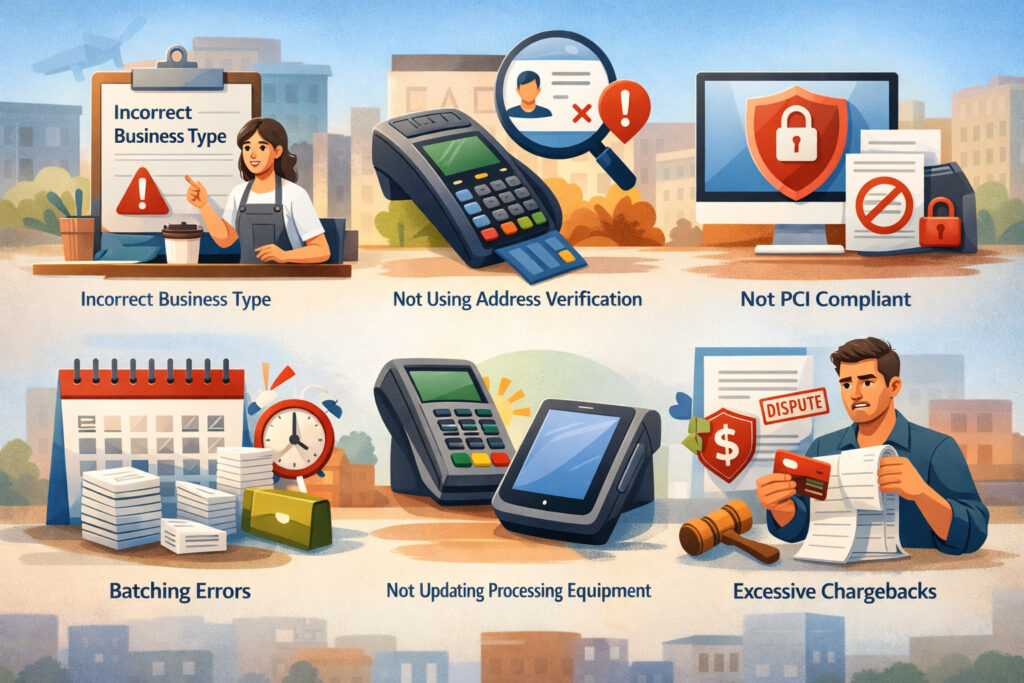
Businesses that want to Cut Credit Card Processing Fees often make the same avoidable mistakes. The good news is that once you know them, you can correct them quickly.
One major mistake is focusing only on the advertised rate. This leads merchants to overlook gateway fees, PCI compliance fees, monthly minimums, and other fixed charges that may matter more than a small change in percentage pricing. Another common mistake is failing to review statements regularly. Without review, fee creep continues unchecked.
Merchants also hurt themselves when they never negotiate. Processors are unlikely to volunteer for better pricing just because your volume has grown. If you do not ask, outdated markup often stays in place.
Another frequent problem is using the wrong payment tools for the sales model. High keyed-in volume, disconnected systems, and outdated terminals or gateways all create unnecessary transaction costs.
Some merchants ignore chargebacks because they see them only as a customer service issue. In reality, they are a payment cost issue too.
Others stay on tiered pricing simply because the statement feels familiar, even though the structure hides what they are really paying. Many businesses also accept vague contract terms that allow pricing changes or lock them into fees that no longer fit the account.
Avoid these mistakes by asking better questions:
- What is my true effective rate?
- What part of my bill is negotiable?
- Which fees add no real value?
- Does my pricing model fit my transaction mix?
- Where are my avoidable costs coming from?
- Could a different setup reduce both fees and operational friction?
Step-by-Step Checklist to Find Savings Opportunities

Use this checklist to evaluate your current provider and identify where you may be able to Reduce Payment Processing Costs right away.
Step 1: Calculate Your Effective Rate
Take your total processing cost for the month and divide it by total card volume. This gives you a clearer measure than the advertised rate.
Step 2: List Every Fixed Monthly Fee
Identify all monthly and periodic charges, including:
- PCI compliance fees
- Gateway fees
- Statement fees
- Batch fees
- Monthly minimums
- Software and reporting fees
- Annual account charges
Step 3: Identify Your Pricing Model
Confirm whether you are on flat-rate pricing, interchange-plus pricing, or tiered pricing. If the answer is unclear, that alone is a warning sign.
Step 4: Review Card-Present vs Card-Not-Present Volume
Estimate how much of your volume is in person, online, invoiced, recurring, or manually keyed. This helps reveal where transaction costs may be inflated.
Step 5: Look for Downgrade Triggers
Check for signs of:
- Excessive key entry
- Delayed settlement
- Missing transaction data
- Outdated equipment or gateway settings
- Inconsistent acceptance methods
Step 6: Review Chargeback Activity
Measure dispute count, reason types, and the operational causes behind them. High chargebacks may be raising your total cost far beyond the fee itself.
Step 7: Ask for a Pricing Review
Request written clarification of markup, monthly fees, and contract terms. Ask whether your current volume qualifies for better pricing.
Step 8: Compare at Least Two Alternatives
Do not compare just the rate. Compare the full cost structure, reporting tools, contract flexibility, support, and fit for your business model.
Step 9: Evaluate Your Payment Stack
Look for duplicate tools, duplicate fees, and workflows that force manual workarounds. A cleaner setup often reduces both cost and friction.
Step 10: Recheck Quarterly
Merchant fees should not be a set-it-and-forget-it expense. Your mix, volume, tools, and pricing leverage can all change over time.
Frequently Asked Questions
How can I reduce my credit card merchant fees without changing providers?
Start by reviewing your merchant statement closely. Calculate your effective rate, identify monthly fixed fees, and look for avoidable costs such as excess key entry, chargebacks, downgrade issues, or services you do not use. Then ask your current provider to review markup, monthly fees, and contract terms. Many businesses can reduce credit card processing fees without switching if they bring clear data to the conversation.
What is the best pricing model to lower credit card merchant fees?
It depends on your business model, but interchange-plus pricing is often preferred by merchants who want pricing transparency because it separates pass-through costs from processor markup. Flat-rate pricing can work for lower-volume businesses that want simplicity, while tiered pricing is often harder to audit. The best model is the one that matches your transaction mix and helps you understand your true effective rate.
Why are my payment processing costs higher than the rate I was quoted?
The quoted rate often does not include all the other charges that affect your real cost. Your statement may also include gateway fees, PCI compliance fees, monthly minimums, chargeback fees, batch fees, higher-cost card-not-present transactions, or nonqualified pricing effects. That is why a merchant statement review is so important.
How do I lower credit card merchant fees for online payments?
Focus on improving your card-not-present setup. Use a strong gateway, reduce manual entry, improve fraud screening, send clear order and billing communications, and monitor chargebacks closely. A smoother and better-protected online payment flow can help reduce merchant processing costs while supporting conversion.
Can chargebacks increase merchant fees?
Yes. Chargebacks create direct fees, but they also add staff time, lost revenue, and potential risk-related pricing pressure. If chargebacks rise, your total payment processing costs often rise with them. Reducing disputes is one of the most practical ways to cut credit card processing fees over time.
Are hidden processing fees common?
They are common enough that every merchant should review statements regularly. Hidden processing fees may include vague monthly charges, duplicated service fees, gateway costs, statement fees, or account maintenance fees that are easy to overlook. These charges can quietly raise your effective rate over time.
How can service businesses save on merchant account fees?
Service businesses often save money by replacing manual key entry with secure invoice links, mobile card readers, or card-on-file billing tools. Clear receipts, recognizable billing descriptors, and better recurring billing communication also help reduce disputes. These changes can save on merchant account fees and improve customer experience at the same time.
Should I use a cash discount program or surcharge to reduce payment costs?
These approaches can reduce the direct cost burden on the business, but they need careful planning. You should consider compliance requirements, customer communication, brand fit, and operational consistency before using them. They work best when evaluated as part of a broader payment strategy rather than as a quick fix.
Conclusion
If you want to Reduce Your Credit Card Merchant Fees, the smartest move is not to chase the lowest advertised number. It is to understand the full cost of card acceptance and attack the parts you can control.
That means reviewing statements carefully, choosing a pricing model that matches your business, negotiating markup and junk fees, reducing avoidable transaction costs, and building a payment setup that fits the way you actually sell.
For some businesses, the biggest savings come from switching away from a vague tiered plan. For others, they come from removing monthly fees, reducing keyed-in volume, improving chargeback control, or consolidating payment tools.
The exact path may differ, but the principle stays the same: lower costs come from better visibility and better decisions.
The best fee-reduction strategy is one that protects customer experience while improving profitability. You should never have to choose between lower merchant fees and smooth operations.
With the right review process and the right payment structure, you can Lower Credit Card Merchant Fees, keep checkout convenient, and hold onto more revenue from every sale.