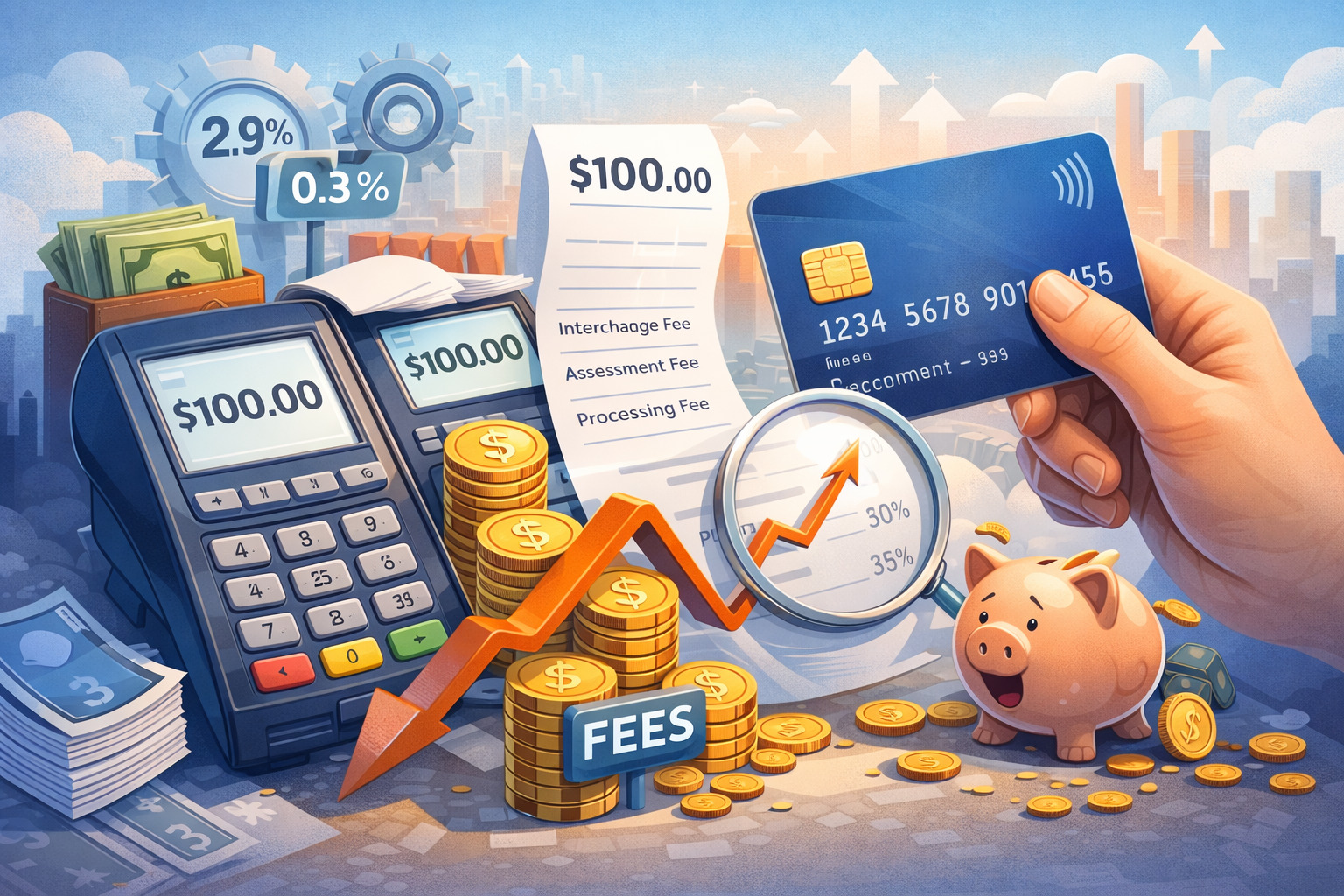
If you run a business that takes card payments, you’ve probably been quoted a “rate” that sounds simple—maybe a percentage plus a small per-transaction fee. But the true cost of accepting credit cards is broader than a single number, and the gap between the quote and the real bill is where many merchants lose money.
The true cost of accepting credit cards includes the obvious line items (like percentage fees), plus the “quiet” costs that show up later: chargebacks, fraud tools, gateway fees, PCI compliance work, hidden network charges, refunds, and even the operational friction at checkout.
In many cases, those indirect costs can materially change your effective rate—especially for ecommerce, delivery, recurring billing, high-ticket sales, or any business with a lot of keyed transactions.
This guide breaks down credit card processing fees from the ground up, explains how pricing models work, shows what drives your effective rate higher, and gives practical ways to lower the credit card processing fees you actually pay.
It also covers what’s changing in card rules, how surcharging and cash-discount programs are evolving, and what future cost trends may look like based on recent network actions and merchant litigation developments.
What “True Cost” Really Means (And Why Your Statement Looks Different Than Your Quote)
When people talk about credit card processing fees, they usually mean “what it costs to accept a card.” But card acceptance is a chain of participants: the customer’s bank, the card network, your processor, your acquiring bank, your gateway, your POS or terminal provider, and sometimes third-party fraud and compliance vendors.
Each layer can add its own credit card processing fees or pass-through charges, which is why your monthly statement may include pages of line items that were never mentioned in the initial pitch.
The true cost of accepting credit cards is best understood as your effective cost, calculated from the total processing-related expenses divided by card sales volume.
That effective cost includes percentage charges, fixed transaction fees, monthly platform fees, chargeback costs, dispute representation fees, authorization fees, batch fees, PCI and security fees, and network charges that can rise with card mix and transaction type.
A common mistake is comparing offers using only a headline rate. Two providers can quote “2.6% + $0.10” and produce very different outcomes once you factor in interchange categories, card-not-present risk, refunds, and additional credit card processing fees.
This is why merchants who focus on “rate” alone often miss the bigger levers: improving qualification, reducing downgrades, lowering chargebacks, and choosing the right pricing model for their sales patterns.
If you want to manage the true cost of accepting credit cards, treat it like a cost system—just like labor or inventory. You need to know what drives it, what you can control, and where you’re paying for risk, convenience, or complexity.
How Card Payments Actually Move (A Simple Map of Who Gets Paid)
To understand why credit card processing fees exist, it helps to see where the money goes. In a typical card transaction, your processor (or payment facilitator) sends authorization data through the card network to the customer’s issuing bank.
The issuer approves or declines based on available funds and risk signals. When the transaction settles, funds flow back through the acquiring side to your merchant account, minus fees.
Most of the cost is not “set by your processor.” Interchange is primarily paid to the issuing bank, and network assessments are paid to the card brand. Visa, for example, describes interchange as a transfer mechanism between financial institutions and distinguishes it from the merchant discount that a business pays to its acquirer/processor.
That’s why card mix matters so much. A premium rewards credit card typically has higher interchange than a basic card. A manually keyed transaction costs more than a chip read. An ecommerce transaction can cost more than a tap in-store transaction. All of these differences show up as higher credit card processing fees, even if you never changed providers.
The bottom line: the true cost of accepting credit cards is the sum of (1) issuer charges, (2) network charges, (3) acquirer/processor margin, plus (4) operational and risk costs. Once you see the map, you can start optimizing the parts you can influence.
The Three Core Buckets of Credit Card Processing Fees: Interchange, Network Fees, and Processor Markup
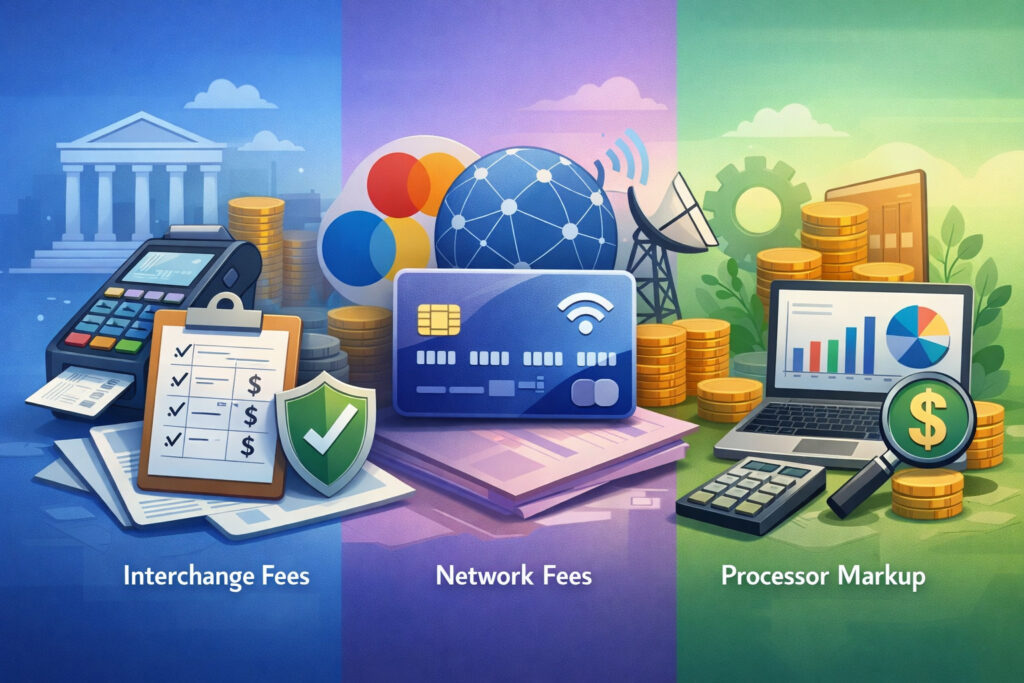
Nearly every card transaction cost can be grouped into three buckets. If you can separate these buckets on your statement, you can diagnose why your credit card processing fees are rising and which levers will actually reduce them.
Interchange is typically the largest share of the true cost of accepting credit cards. It’s paid from the acquiring side to the issuing bank.
It varies based on card type (debit vs credit, consumer vs commercial), acceptance method (chip, tap, ecommerce, keyed), data quality (AVS, CVV, Level 2/3), and merchant category. Mastercard’s own merchant support pages describe interchange as fees paid by acquirers to issuers and note it is updated for the region.
Network assessments (sometimes called assessment fees, brand fees, or network fees) are charged by the card networks for using their rails. These can include volume-based basis-point fees, per-item fees, and monthly fees tied to volume or merchant category. Visa also publishes documentation and guidance around fees and rules for partners and merchants.
Processor/acquirer markup is what you pay your provider for their services—risk management, funding, reporting, support, underwriting, and the technology layer. This is the bucket you can negotiate most directly, but it’s not always the biggest bucket.
If your provider bundles everything into one blended rate, you’ll still pay all three buckets—you just won’t see them clearly. For long-term cost control, clarity matters because it helps you target the real drivers of credit card processing fees.
Interchange: The Hidden Variable That Changes With Card Mix and Data Quality
Interchange is not a single fee. It’s a matrix of categories with different rates and conditions. Even small operational details can cause a “downgrade” into a more expensive category, raising your credit card processing fees without any change to your provider.
Examples of factors that affect interchange include:
- Card type: consumer debit, consumer credit, business/commercial, purchasing, corporate, and premium rewards products.
- Transaction environment: card-present vs ecommerce vs mail/phone order vs recurring.
- Verification and data: address verification, CVV, tokenization, and higher data levels (Level 2/Level 3 for certain card types).
- Timing and settlement: late settlement can trigger more expensive categories.
- Refunds and partial captures: can create additional per-item fees and operational costs.
Card networks publish current interchange program documents and updates. Mastercard, for instance, provides downloadable rate documents for the region, underscoring that the fee environment changes over time.
To manage the true cost of accepting credit cards, you don’t need to memorize interchange tables. You need to control the conditions you can control: how you accept the card, what data you collect, how quickly you settle, and how clean your transactions are.
Pricing Models Explained: Flat Rate, Tiered, Interchange-Plus, Subscription, and “Zero-Fee” Programs
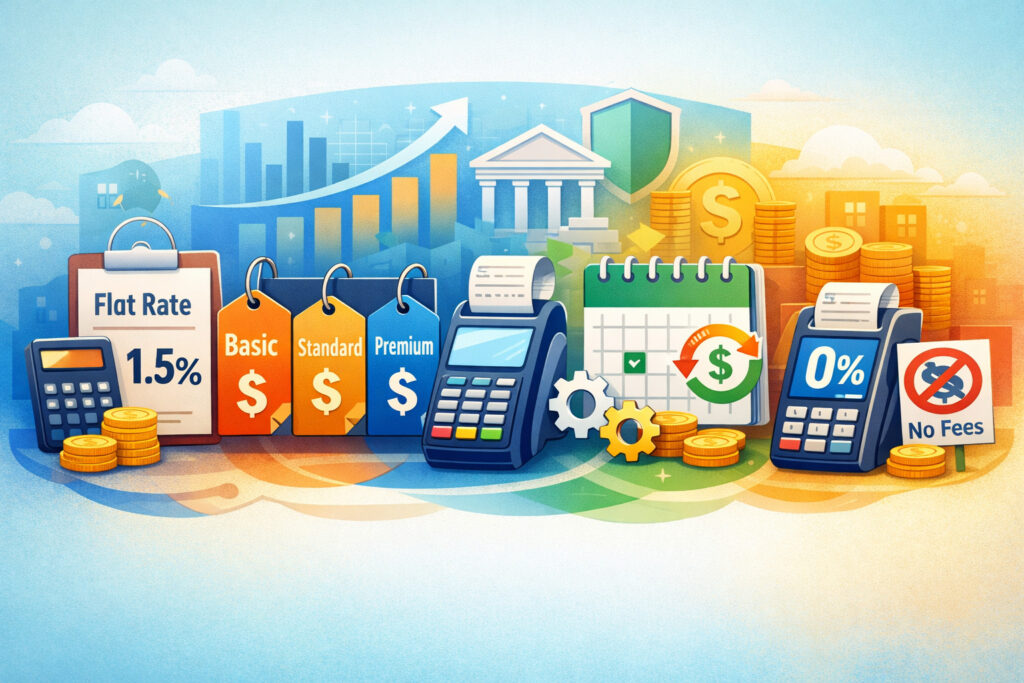
Your pricing model determines how transparent your credit card processing fees will be—and how your costs behave as your card mix changes. Many merchants only learn the downside of a model when volume grows, refunds increase, or their sales move online.
Flat-rate pricing is simple and predictable, often popular with new or very small businesses. The tradeoff is you may overpay when customers use lower-cost debit cards, because the flat price averages everything. Your credit card processing fees become “easy to budget,” but not necessarily low.
Tiered pricing groups transactions into buckets like “qualified,” “mid-qualified,” and “non-qualified.” This model can create confusion because the provider controls how transactions land in each tier.
Two merchants with identical sales can see different tier results based on setup, settlement timing, or how the provider defines “qualified.” This makes it harder to manage the true cost of accepting credit cards.
Interchange-plus pricing separates interchange and network fees from the processor’s markup. Many merchants prefer it because it reveals the true components of credit card processing fees and makes it easier to negotiate the markup without hiding increases behind “rate changes.”
Subscription or membership pricing charges a fixed monthly fee plus lower per-transaction markup. It can reduce credit card processing fees for higher-volume merchants with stable ticket sizes.
Cash-discount and surcharge programs aim to shift some cost to the customer. These can reduce the merchant’s out-of-pocket credit card processing fees, but they must be implemented carefully for compliance and customer experience reasons.
Choosing the right model depends on your ticket size, risk profile, channel mix, refunds, and growth plans. If you want a model that scales cleanly, you’ll typically prioritize transparency and controllability over simplicity.
How to Compare Offers the Right Way (Effective Rate, Not Headline Rate)
Comparing offers by headline rate is like comparing shipping costs without weighing the package. To compare credit card processing fees accurately, calculate an effective cost using realistic assumptions about your card mix.
Start by pulling three months of statements. Identify total card volume, total fees, and any non-processing charges that still exist because you accept cards (gateway, PCI, device rental, chargebacks, monthly minimums).
Your effective rate is total fees divided by volume. Then segment by channel: in-store vs ecommerce vs keyed. This reveals where your credit card processing fees are being generated.
Next, look for patterns:
- Are keyed transactions common?
- Is settlement delayed?
- Are you seeing many “non-qualified” or “downgraded” lines?
- Are network fees rising faster than processor markup?
Because interchange and network fees change over time, you should also ask how your provider handles pass-through updates. Card brands publish rule documents and fee schedules that evolve, so your comparison should include how the provider communicates changes and how clearly they show pass-through items.
Finally, include operational realities: support quality, funding speed, dispute help, and fraud tooling. A cheaper headline rate that leads to more chargebacks can raise the true cost of accepting credit cards.
Operational Costs That Quietly Raise the True Cost of Accepting Credit Cards
Many merchants focus on percentage rates while ignoring the operational layer. But operational friction can inflate credit card processing fees in the form of extra authorizations, reversals, refunds, and preventable errors that cause downgrades or disputes.
For in-person businesses, the biggest operational driver is how the card is captured. Chip and tap usually reduce fraud exposure compared to magnetic stripe or manual entry.
If staff often key in numbers because terminals are slow, connectivity is weak, or the checkout flow is poorly designed, you can see higher declines and higher credit card processing fees over time.
For ecommerce, the drivers are different: checkout conversion, verification steps, and the balance between fraud prevention and customer friction. Overly strict filters can block good customers, while weak filters can cause chargebacks—either way raising the true cost of accepting credit cards.
Refund management is another hidden cost. Refunds don’t always reverse all fees, and they can increase customer service workload.
Partial refunds, multiple shipments, and split tender transactions complicate reconciliation and can increase the number of transactions you process—raising per-item credit card processing fees even if your percentage stays the same.
Lastly, device and software choices matter. Some “low-rate” deals include expensive terminal leases, add-on POS modules, premium support tiers, or gateway fees that keep your effective credit card processing fees high. Operational choices are often the easiest wins because they reduce cost without needing to renegotiate a contract.
POS, Gateway, and Tokenization: The Technology Layer That Adds Fees (or Saves Them)
Your tech stack can increase or decrease credit card processing fees depending on how it’s configured. Gateways often charge per-transaction fees, monthly fees, tokenization fees, or additional charges for advanced fraud tools. Some processors bundle these, while others itemize them.
Tokenization and network token programs can reduce risk and improve authorization rates by replacing stored card numbers with tokens.
Better authorization rates reduce retries, reduce declined orders, and can lower the effective true cost of accepting credit cards—even if the per-transaction fee is slightly higher—because you capture more revenue with fewer failed attempts.
Data quality is also a cost lever. For card-not-present transactions, ensuring you collect accurate billing ZIP and CVV when appropriate can reduce fraud and disputes. Clean data also helps prevent downgrades into more expensive interchange categories, indirectly lowering credit card processing fees.
Integration quality matters, too. Poorly built integrations may trigger duplicate authorizations, delayed captures, or late settlements. These issues can be invisible day-to-day but show up in monthly costs.
A well-integrated POS and gateway setup reduces operational waste, making your credit card processing fees more predictable and your effective rate lower.
Risk Costs: Chargebacks, Fraud, and Disputes (The “Second Bill” of Card Acceptance)
Chargebacks are where many businesses discover the real true cost of accepting credit cards. The percentage you pay for processing is only part of the story; disputes create direct fees plus indirect losses like inventory, shipping, staff time, and higher future risk pricing.
Every chargeback typically includes a fee from the processor/acquirer and can trigger additional costs if you fight it (representation tools, evidence gathering, third-party alerts). If you lose, you often lose the sale amount plus shipping and product cost. Even if you win, your operational cost can be significant.
Fraud prevention also has a cost curve. Tools like 3DS, AVS filters, device fingerprinting, and velocity controls can lower chargebacks, but they can reduce conversion if configured too aggressively. The goal is to minimize total cost: fraud losses + disputes + lost sales + credit card processing fees.
Risk also affects approvals. Issuers may decline transactions that appear risky, forcing customers to retry with different cards. Retries create extra authorization traffic and sometimes extra per-item credit card processing fees.
Over time, high dispute ratios can also lead to monitoring programs, increased reserves, or account termination—turning “fees” into existential risk.
This is why the lowest processing rate is not always the lowest true cost of accepting credit cards. A slightly higher markup with better fraud tooling, smarter routing, and stronger dispute support can reduce total cost.
The Metrics That Matter: Chargeback Ratio, Authorization Rate, Refund Rate, and Fraud-to-Sales
To control credit card processing fees and the broader acceptance cost, track four metrics monthly:
- Authorization rate: approvals divided by attempts. A low rate can indicate fraud flags, poor data quality, or routing issues.
- Chargeback ratio: disputes divided by transactions or sales volume. Rising ratios create program risk.
- Refund rate: refunds divided by sales. High refund rates create operational cost and can increase effective credit card processing fees if fees aren’t fully reversed.
- Fraud-to-sales: confirmed fraud losses divided by sales. This helps you decide whether to tighten controls or loosen them.
These metrics help you identify whether costs are driven by card mix (interchange), provider pricing (markup), or business operations (risk and process). Interchange tables can change twice a year, but operational improvements can lower the true cost of accepting credit cards immediately—without waiting for negotiations or market shifts.
If you only do one thing: separate your “processing cost” from your “risk cost.” Many merchants blend them mentally and miss the real fixes.
Compliance and Rules: Surcharging, Cash Discount, and Customer Disclosures
Many merchants explore surcharging or cash-discount programs as a way to reduce credit card processing fees. These approaches can work, but they must follow card network rules and applicable laws. Visa and Mastercard both publish merchant guidance on surcharging, including disclosure requirements and caps.
In practice, compliance usually comes down to three categories:
- Disclosure: clear notices at entry points and at checkout, plus itemized receipt disclosures where required by rules.
- Caps and product limitations: networks typically limit surcharge amounts and define which products can be surcharged (often credit, not debit), plus rules about how the surcharge is applied.
- Operational setup: POS configuration, signage, staff scripting, and consistent application.
Cash discount programs are often positioned differently: instead of adding a surcharge to card sales, the merchant posts a “cash price” and applies a service fee to card transactions. The practical goal is similar—offset credit card processing fees—but the labeling, signage, and implementation must be done carefully to avoid customer confusion.
Also consider customer experience. If surcharging increases cart abandonment or causes complaints, your total profitability can drop even if your credit card processing fees decrease. The smartest approach is to model the change: estimate how much cost you shift, then estimate potential conversion impact.
When it’s necessary to be explicit: these rules and disclosures vary across jurisdictions and states within the United States, so merchants should confirm local requirements and network rules before implementing surcharging.
PCI Compliance and Security Programs: The Cost of Staying Eligible to Accept Cards
PCI compliance is a major piece of the true cost of accepting credit cards because it mixes security requirements with recurring administrative work. The cost isn’t only the compliance fee (if your provider charges one).
It’s also the time spent completing questionnaires, maintaining secure systems, updating devices, and responding to provider requests.
Your compliance burden depends heavily on how you accept cards:
- If you use a hosted checkout or fully tokenized solution, your PCI scope can be lower.
- If you store card data, process through custom forms, or handle card data directly, your scope increases—and so does cost.
Security tools like tokenization, point-to-point encryption, and EMV devices may reduce fraud and lower the chance of costly incidents. This can reduce the effective credit card processing fees indirectly by lowering disputes and operational losses.
The strategic view is this: PCI is not just a “fee.” It’s a risk control that helps you keep processing privileges and avoid catastrophic costs. The cheapest compliance option is often the one that reduces your data exposure the most, even if the monthly platform cost is slightly higher.
How to Reduce Credit Card Processing Fees Without Hurting Sales
Reducing credit card processing fees is not about chasing a magic low rate. It’s about tightening operations, improving data quality, choosing the right pricing structure, and negotiating from a position of clarity.
Start with transaction hygiene:
- Use chip/tap where possible.
- Avoid manual entry except when truly necessary.
- Settle daily, and avoid delayed captures.
- For ecommerce, use accurate descriptors and clean billing data to reduce disputes.
Then optimize your pricing setup:
- If you have stable volume, consider interchange-plus or subscription pricing for transparency and control.
- Audit monthly fees: gateways, statement fees, PCI fees, device rentals, “non-compliance” penalties.
- Push back on junk fees that don’t reflect actual value.
Next, reduce disputes:
- Improve receipts, delivery confirmation, and customer communication.
- Make refund policies clear and easy.
- Use fraud tools calibrated to your business model.
Finally, renegotiate with evidence. When you can show your effective rate, your average ticket, your chargeback ratio, and your volume growth, you’re better positioned to reduce markup and avoid unnecessary credit card processing fees.
Done correctly, these steps reduce your total cost while protecting conversion and customer satisfaction—the real goal behind lowering the true cost of accepting credit cards.
Negotiation Checklist: What to Ask For (and What to Watch Out For)
When negotiating credit card processing fees, ask questions that force clarity:
- What is the exact markup over interchange (percentage and per-item)?
- Are network assessments passed through at cost and shown transparently?
- What monthly fees exist now and what can be waived?
- Are there annual fees, minimums, batch fees, PCI fees, or “non-compliance” fees?
- How are chargebacks priced (fee per dispute, representation fees, alert fees)?
- Are terminals purchased, rented, or leased—and what is the total cost over time?
Also ask about operational support: funding timelines, chargeback assistance, and fraud tooling. These aren’t “nice-to-haves.” They change the true cost of accepting credit cards.
Watch for red flags:
- Vague “qualified” tiers with no written definitions.
- Long-term leases on equipment.
- “Too good to be true” offers that rely on extra fees later.
- Contracts that allow broad unilateral fee increases without transparency.
A provider that can show you interchange, assessments, and markup clearly is usually a safer long-term partner for managing credit card processing fees.
What’s Changing Now and Future Predictions for the True Cost of Accepting Credit Cards
Card costs are not static. Interchange and network programs update regularly, and merchant rules are influenced by regulation, litigation, and competitive pressures.
Recent reporting highlights continuing merchant disputes and proposed settlements involving interchange and acceptance rules, with discussion of modest average fee reductions and changes in card acceptance flexibility—subject to court approval and ongoing debate among trade groups.
What this suggests for merchants:
- Pressure for transparency will increase: Whether through legal settlements, market competition, or merchant advocacy, businesses will demand clearer itemization of credit card processing fees and more control over acceptance choices.
- Rewards economics will stay in focus: Premium rewards products are often tied to higher interchange. Any changes that allow merchants more flexibility could influence card mix over time, which would affect the true cost of accepting credit cards.
- Fraud and authentication costs will keep rising for ecommerce: As fraud shifts to digital channels, merchants will spend more on tools and workflows. Even if headline credit card processing fees stay steady, total acceptance cost can rise if chargebacks and fraud losses increase.
- Alternative rails and real-time payments will grow, but cards will remain dominant for many use cases: Cards offer consumer protections, broad acceptance, and embedded credit—so the “cost vs convenience” tradeoff will continue.
A practical prediction: the merchants who win will be the ones who treat card acceptance like a performance system—routing, data quality, fraud controls, and pricing structure—not just a vendor decision. That approach reduces the true cost of accepting credit cards even when market-wide fees drift upward.
FAQs
Q.1: What is the average cost of accepting cards for a small business?
Answer: Average credit card processing fees vary widely based on industry, ticket size, and whether sales are in-person or online. Many merchants experience an effective rate that moves month to month due to card mix (debit vs credit, rewards vs non-rewards), keyed vs chip/tap, and dispute levels.
The most accurate way to find your number is to calculate total processing-related charges divided by card volume over at least three months.
Q.2: Are debit card transactions always cheaper than credit card transactions?
Answer: Often, but not always. Debit can have lower interchange in many cases, but the effective credit card processing fees can rise if the transaction is keyed, if additional network fees apply, or if your pricing model doesn’t pass through lower costs. Operational setup and pricing structure matter as much as the payment type.
Q.3: Do refunds reduce processing fees?
Answer: Refunds usually reverse the sale amount, but they don’t always reverse every component of credit card processing fees. Some providers keep certain per-transaction fees. High refund rates also increase operational cost and can affect fraud and dispute patterns.
Q.4: Is surcharging legal and allowed by the card networks?
Answer: In many places it can be allowed with restrictions, but rules and laws vary. Visa and Mastercard publish surcharging guidance and disclosure requirements, including caps and operational rules merchants must follow.
Q.5: What’s the fastest way to reduce credit card processing fees?
Answer: The fastest wins usually come from fixing transaction hygiene (chip/tap, fewer keyed entries, daily settlement), reducing chargebacks, and eliminating unnecessary monthly add-ons. Then renegotiate markup using your effective-rate analysis and volume profile.
Conclusion
The true cost of accepting credit cards is bigger than the quoted rate. It includes interchange, network assessments, processor markup, and the operational reality of running card payments day after day—fraud tools, chargebacks, refunds, devices, gateways, and compliance.
Visa and Mastercard publish rules and guidance that show how structured and evolving this ecosystem is, and recent merchant settlement reporting underscores that cost and acceptance flexibility remain active, changing topics.
If you want to lower credit card processing fees sustainably, focus on what you can control: how you accept cards, the data you collect, how you prevent disputes, and how transparent your pricing model is.
Calculate your effective rate, identify the biggest drivers, and optimize systematically. That’s how you reduce cost without sacrificing sales—and how you keep the true cost of accepting credit cards from quietly eating your margins.