By alphacardprocess February 4, 2026
Merchant services pricing models determine how much you pay to accept card and digital payments—and why your monthly statement can feel confusing. The best way to lower cost isn’t chasing the lowest “rate.”
It’s choosing a merchant services pricing model that matches your business type, ticket size, card mix, and risk profile, then negotiating the right line items and operational habits.
At a high level, most merchant services pricing models are built from the same cost stack: interchange (paid to the card-issuing bank), network assessments/fees (set by the card networks), and processor/acquirer markup (the provider’s margin plus platform costs).
Interchange is not one universal number—it varies by card type, rewards level, how you accept the card (tap, chip, key-entered, online), your merchant category code, and data quality. Visa and Mastercard publish rules and interchange information for partners and provide references that explain how interchange works and why it changes.
This guide breaks down the major merchant services pricing models, how providers structure profit, the traps to avoid, and how to predict cost changes in the next 12–24 months.
Throughout, you’ll see the phrase merchant services pricing models often—because understanding merchant services pricing models is the single most reliable way to control payment acceptance costs without harming conversion.
How Merchant Services Pricing Models Really Work (The Cost Stack You’re Paying For)
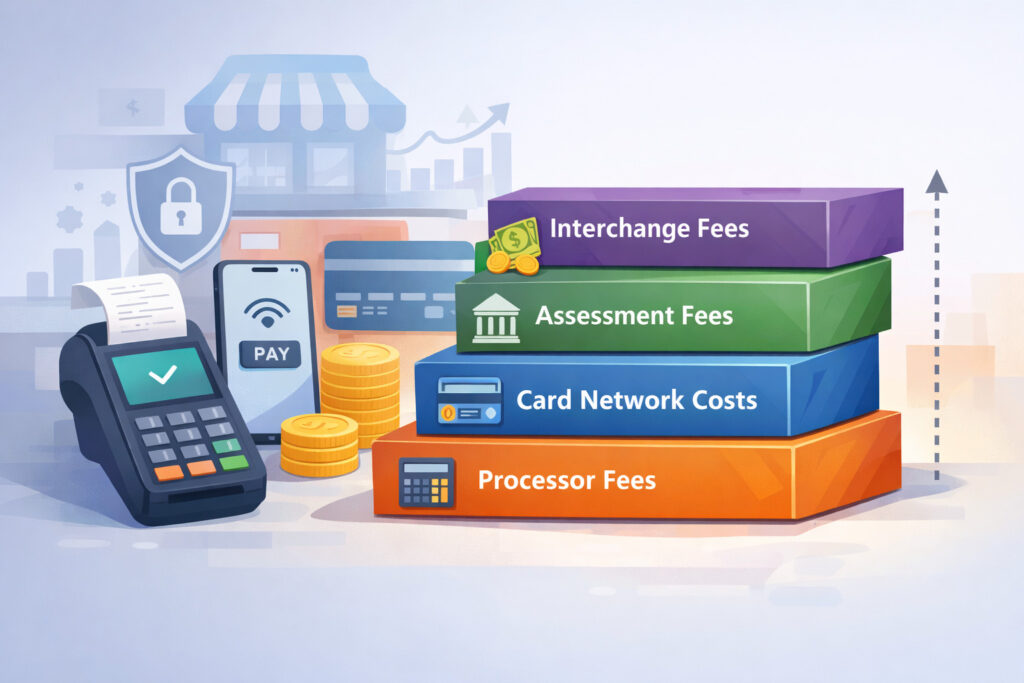
Every merchant services pricing model is a different way of packaging the same underlying economics. Your true base cost starts with interchange (issuer fees) and network assessments, then adds provider markup and operational line items.
Interchange is often the biggest portion for credit cards, and it is not negotiable in the way sales reps imply. Mastercard, for example, describes interchange as fees paid by acquirers to issuers, and it publishes current regional interchange programs and rate documents.
What is negotiable depends on the merchant services pricing model: markup, per-transaction fees, monthly minimums, gateway fees, “non-qualified” add-ons, and a long list of small recurring charges.
This is why merchant services pricing models can feel like apples-to-oranges comparisons. A “2.6% + 10¢” ad can be cheaper for one business and dramatically worse for another, even at the same volume.
There’s also a timing reality: card networks frequently update interchange and related programs on a recurring cadence (commonly April and October updates are widely referenced in industry summaries). When interchange shifts, your bill shifts—unless your merchant services pricing model isolates pass-through costs clearly.
Finally, pricing isn’t only math; it’s behavior. The same merchant services pricing model can produce different effective rates depending on how you accept cards (chip/tap vs keyed), your refund rate, chargeback ratio, and whether your transactions qualify for the best categories (correct data, settlement timing, AVS match for ecommerce, etc.).
So, the goal is not just selecting merchant services pricing models—it’s selecting a model and operating in a way that consistently qualifies for lower-cost categories.
Interchange-Plus Pricing (Cost-Plus) — The Most Transparent Merchant Services Pricing Model

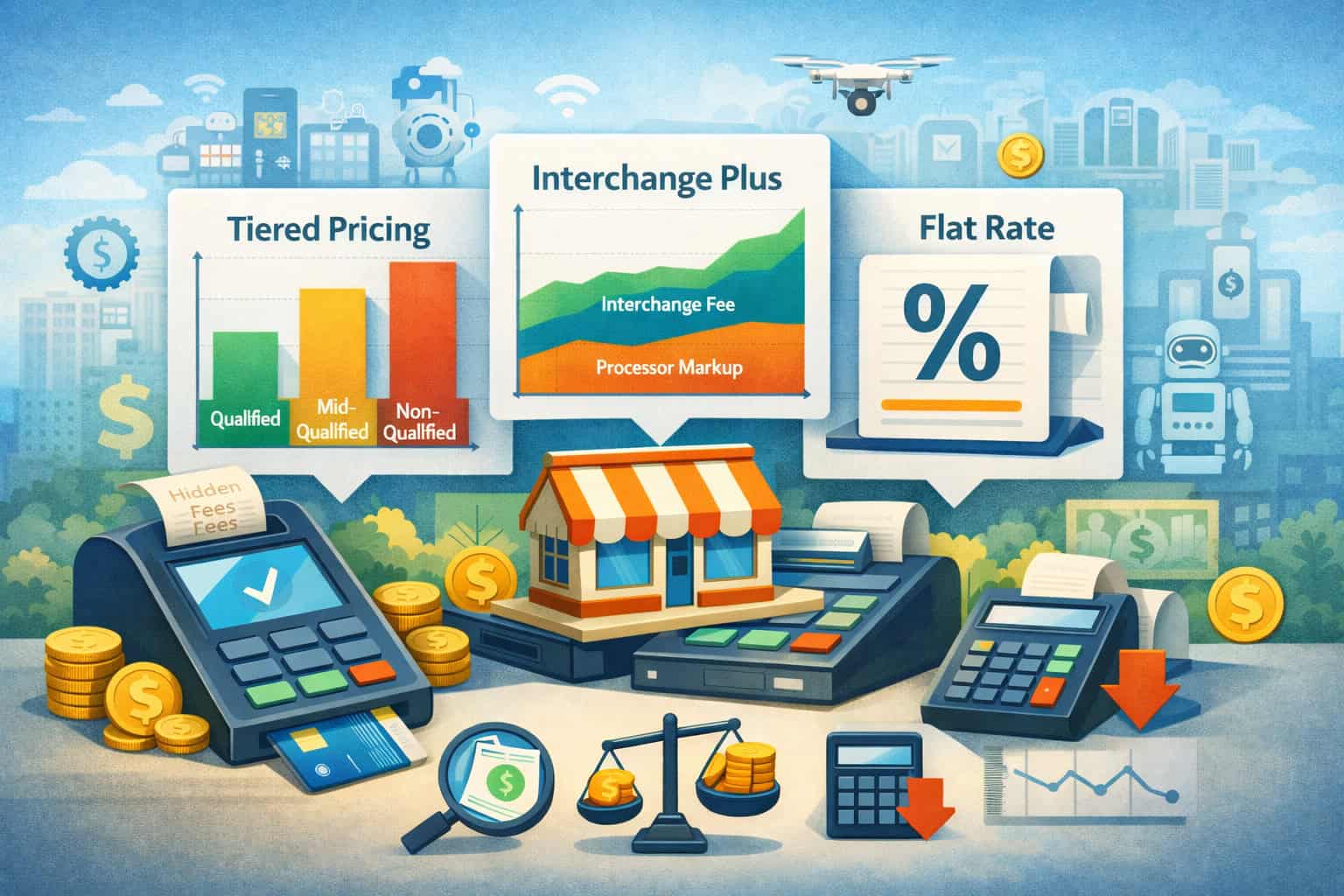
Interchange-plus (often called “cost-plus” or “IC++”) is widely considered the most transparent of the merchant services pricing models.
You pay the actual interchange and network assessments as pass-through costs, then you pay a clearly defined markup to your provider—usually expressed as a percentage plus a per-transaction fee (example: interchange + 0.25% + 10¢).
In plain terms: if interchange rises or falls, you see it; if your card mix shifts to more premium rewards cards, you see it; and if your provider markup is fair, you can predict cost with fewer surprises.
This merchant services pricing model works especially well for established businesses that want stable reporting and the ability to benchmark offers. It also makes it easier to negotiate: you can ask for a lower markup, reduced per-item fees, fewer monthly add-ons, and cleaner pass-through handling.
Because interchange itself changes by category, interchange-plus helps you connect business decisions to outcomes—like why keyed transactions cost more than tap, or why ecommerce with poor address verification can price higher.
Interchange-plus also aligns with how networks describe interchange in principle: fees are determined by card type, acceptance method, and program rules, and merchants typically work with their acquirer/provider for the rest of the stack.
That said, interchange-plus is not automatically “cheap.” Providers can still add extra “junk fees” or inflate pass-throughs using vague labels (e.g., “network fee,” “regulatory fee,” “service fee”) if the contract allows it.
For many operators, interchange-plus is the merchant services pricing model that is easiest to audit and optimize over time. If you’re serious about long-term savings, interchange-plus is often the baseline used to compare all other merchant services pricing models—because it lets you see exactly what is provider margin versus what is pass-through cost.
Tiered Pricing (Qualified / Mid-Qualified / Non-Qualified) — The Most Confusing Merchant Services Pricing Model

Tiered pricing bundles transactions into broad buckets—commonly “qualified,” “mid-qualified,” and “non-qualified”—each with a different rate. This is one of the most common merchant services pricing models offered to small businesses because it sounds simple (“as low as 1.69%!”) while hiding the real distribution of your transactions.
The core issue: your provider decides what counts as each tier, and many everyday transactions can fall into the more expensive tiers due to card type (rewards), acceptance method (keyed), business category, or missing data.
In practice, tiered pricing often becomes a margin amplifier. The “qualified” tier might apply to a narrow slice of debit or basic consumer cards processed in-person with perfect data. Meanwhile, premium rewards, business cards, ecommerce, keyed, or higher-risk categories can land in “non-qualified” with a rate that’s materially higher than true underlying cost.
Tiered merchant services pricing models can still be workable in limited scenarios—like very small volume where the provider offers strong support and the tier definitions are unusually fair.
But most businesses struggle to forecast costs because they can’t see the actual interchange categories driving qualification. If interchange updates occur (commonly referenced around April and October), the provider may re-map tiers or adjust tier pricing, and you may not see a clean explanation.
If you’re presented tiered pricing, demand clarity: what percentage of your volume is expected to land in each tier based on your real statements? Which card types and acceptance methods trigger downgrades?
Without that, tiered pricing is usually the merchant services pricing model most likely to inflate your effective rate over time, especially as consumers migrate to premium rewards products.
Flat-Rate Pricing (Simple Pricing) — Predictable, But Often Pricier at Scale

Flat-rate pricing is the “simple pricing” approach often advertised as a single rate for most transactions (example: 2.6% + 10¢).
This merchant services pricing model is popular for startups, micro-merchants, pop-up sellers, and service providers who value predictable cash flow more than fine-tuned optimization. Flat-rate pricing is easy to budget, easy to understand, and often includes basic software features bundled in.
But flat-rate merchant services pricing models usually price in a cushion for risk, rewards card mix, and interchange variability. That means you may overpay when you accept lower-cost payment types (like certain debit transactions) or when your business would otherwise qualify for efficient categories.
For growing businesses, the pain shows up as volume increases: what felt acceptable at $10,000/month can become expensive at $150,000/month.
Flat-rate pricing also can mask the effect of interchange changes. Interchange and network programs do change over time, and when they do, flat-rate providers may adjust their published rates or modify included services to preserve margin. Industry commentary frequently highlights ongoing interchange evolution and scrutiny on fees into 2026.
Still, flat-rate can be the right merchant services pricing model when you need a fast setup, minimal statement complexity, and the provider’s tooling (invoicing, links, subscriptions) is part of the value.
The key is knowing when to “graduate” to interchange-plus or a customized pricing plan. As a rule, once payments become a significant cost center, the best merchant services pricing models are usually the ones you can audit line-by-line.
Subscription Pricing (Membership + Wholesale) — A Modern Merchant Services Pricing Model With Tradeoffs
Subscription pricing (also called “membership pricing”) typically charges a fixed monthly fee (e.g., $79/month) plus low per-transaction costs, while passing interchange through at cost. Many providers market this as “wholesale” processing.
In theory, it’s one of the most business-friendly merchant services pricing models because it separates provider profit (the subscription) from transaction economics (interchange + small per-item fees).
This model can be strong for high-volume merchants with stable transaction counts, because a fixed subscription becomes cheaper per dollar processed as volume increases. It can also reduce the psychological friction of percentage markups, making your provider’s margin visible and predictable.
But subscription merchant services pricing models have important caveats. First, you must confirm what “at cost” means: are network assessments passed through exactly, or bundled and marked up?
Second, subscription plans often have tiered membership levels based on volume, and moving tiers can create sudden cost jumps. Third, if your processing volume fluctuates seasonally, the fixed fee can be painful during slow months.
Subscription pricing also doesn’t automatically solve operational downgrades. You still pay interchange categories based on how you accept cards and your data quality. Mastercard and Visa publish extensive program rules, and qualification still matters even when your provider’s margin is “simple.”
Among merchant services pricing models, subscription pricing is best evaluated using your real transaction count and volume. If you run a statement analysis and the math works, it can be a strong long-term fit. If you don’t, you risk paying a premium subscription for volume you don’t consistently have.
Cash Discount, Convenience Fees, and Surcharging (Compliance-Heavy Merchant Services Pricing Models)
Some merchant services pricing models reduce merchant cost by shifting part of the acceptance cost to the customer—through cash discount programs, convenience fees, or credit card surcharges.
These are not interchangeable terms, and mixing them up creates compliance risk, customer backlash, and potential network violations.
Card network guidance and business advocacy guides emphasize that surcharging rules apply to credit cards (not debit), with specific disclosure requirements and limitations.
For example, Visa’s merchant surcharging Q&A explains what a surcharge is and notes that merchants in most states may add a surcharge to credit card transactions subject to limitations and conditions.
Industry guidance also commonly notes that debit surcharging is prohibited under federal rules, and that merchants should consult counsel for compliance.
State rules vary, and they can change. Recent state-by-state references exist, but they also warn that rules evolve and should be verified. That variability is why these merchant services pricing models require careful implementation: signage, receipts, register prompts, correct fee caps, and correct treatment of debit cards.
From a customer-experience standpoint, these models can backfire if presented poorly. A surprise fee at checkout can reduce conversion, raise dispute risk, and damage reviews. If you choose these merchant services pricing models, treat them as a compliance project: implement clear disclosure, train staff, and monitor chargebacks.
Future-looking note: scrutiny on card acceptance fees and merchant flexibility remains an active topic in the market, including ongoing disputes and settlements that could influence how merchants approach acceptance and steering.
Whether rules become more permissive or more restrictive, “fee shifting” merchant services pricing models will likely remain under the microscope—so document your approach and stay ready to adjust.
What’s Hidden in the Fine Print (Where Merchant Services Pricing Models Make or Break You)
Even the best merchant services pricing models can become expensive due to add-ons and contractual traps. This is where merchants lose money—not because interchange is mysterious, but because providers introduce revenue through layered fees that aren’t part of the headline quote.
Common line items include: statement fees, PCI program fees, monthly minimums, gateway fees, tokenization vault fees, batch fees, AVS fees, chargeback handling fees, retrieval fees, address verification add-ons, and “regulatory” or “network” fees with vague definitions. Some of these may be legitimate pass-through or service costs; others are margin disguised as compliance.
You should also watch for rate review clauses that allow the provider to change pricing with minimal notice, and for long auto-renewals that lock you into outdated merchant services pricing models.
Another risk: “bundled” pricing that changes based on processor discretion. Tiered plans are especially vulnerable here, but any merchant services pricing model can be modified by policy if the contract permits.
Operationally, the biggest hidden cost is downgrades—transactions that should qualify for a lower category but don’t because of late settlement, missing fields, mismatched address data, or incorrect transaction type.
Because interchange and network rules are updated and published, qualification standards can evolve. The best defense is insisting on clear reporting: your provider should show effective rate, transaction mix, and the markup separately when possible.
If your goal is to rank and win in your category, choose merchant services pricing models that are auditable. The ability to prove where costs come from is what gives you negotiating power—and it’s what keeps “small” monthly fees from silently turning into meaningful annual waste.
How to Choose the Right Merchant Services Pricing Model (By Business Type and Payment Mix)
Choosing among merchant services pricing models should start with your realities: average ticket, card-present vs card-not-present share, refund rate, chargeback exposure, and monthly volume. Then you map those to the model that minimizes downside.
If you are early-stage or low volume, flat-rate merchant services pricing models may be acceptable because simplicity matters. If you are scaling, interchange-plus often becomes the best default because transparency lets you tune operations and negotiate markup.
If you are high volume with stable transaction counts, subscription pricing can outperform percentage markups. If you have tight margins and price-insensitive customers, a carefully compliant fee-shifting approach may make sense—but it must be implemented within network rules and applicable state requirements.
Don’t ignore “soft costs.” For ecommerce, fraud tools and dispute management can be worth more than a few basis points. For in-person retail, uptime, terminal replacement policy, and support responsiveness can matter more than chasing the last 0.05%.
Merchant services pricing models live inside an operating system: your POS, gateway, invoicing, reporting, and chargeback workflow.
Also consider the broader direction of the market. Interchange categories and programs continue to evolve, and public scrutiny on acceptance fees remains active.
That suggests future merchant services pricing models will increasingly reward strong data, modern acceptance methods (tap, tokenization), and dispute efficiency—while penalizing messy operations, manual key-entry, and high-risk patterns.
A practical selection framework: shortlist two merchant services pricing models (usually interchange-plus vs your current plan), run a 90-day statement analysis, then negotiate markup and fee cleanup based on evidence. That’s how you turn merchant services pricing models into a cost-control lever rather than a recurring surprise.
Future Predictions for Merchant Services Pricing Models (2026–2028)
Looking forward, merchant services pricing models are likely to shift in three main ways.
First, more granular pricing and reporting. As interchange programs evolve and networks refine qualification logic, merchants will demand clearer pass-through accounting.
Mastercard and Visa already publish extensive program materials and partner guidance; the market pressure is moving toward transparency as a competitive advantage. Providers that can’t separate interchange, assessments, and markup cleanly will face more churn from merchants who learn how merchant services pricing models work.
Second, fee pressure and merchant flexibility debates will continue. The long-running conflict between large merchants and card networks remains active, including settlements and policy discussions about interchange levels and acceptance rules.
Even without dramatic legal change, ongoing scrutiny tends to push providers toward clearer merchant services pricing models and away from the most opaque packaging.
Third, compliance-driven pricing will grow. Surcharging, cash discounting, and similar approaches will remain attractive in certain sectors, but they will also remain compliance-heavy due to varying state rules and network disclosure requirements.
This will create demand for “managed compliance” bundles—merchant services pricing models that include signage templates, receipt formatting, training materials, and monitoring.
FAQs
Q.1: What is the best merchant services pricing model for most established businesses?
Answer: For many established operators, interchange-plus is often the most reliable merchant services pricing model because it is auditable: you can see pass-through costs and provider markup separately and negotiate based on evidence.
Q.2: Why does my effective rate change month to month even if my rate didn’t?
Answer: Because interchange and assessments vary by card type and acceptance method, and because your monthly mix changes. Even under the same merchant services pricing model, more premium rewards, more keyed transactions, or more ecommerce can raise your effective rate.
Q.3: Are tiered pricing plans always bad?
Answer: Not always, but they are the easiest merchant services pricing models to manipulate through tier definitions and downgrades. If you can’t validate how transactions fall into tiers using real statements, you’re taking a risk.
Q.4: Can I add a surcharge to all card payments?
Answer: Rules generally distinguish credit vs debit and often require specific disclosures and limits. Visa’s guidance describes surcharging rules and conditions, and state requirements may also apply—so it’s a compliance decision, not just a pricing decision.
Q.5: How often do interchange and network fees change?
Answer: Industry references commonly discuss recurring updates (often around April and October), though the details depend on each network’s programs and publications.
Conclusion
Merchant services pricing models are not just “rates”—they are systems for distributing cost, risk, and incentives across issuers, networks, providers, and merchants. If you want predictable margins, pick merchant services pricing models you can audit, negotiate, and operationalize.
In most cases, interchange-plus is the clearest long-term foundation because it shows pass-through costs separately from provider markup. Flat-rate can be a smart early-stage choice when simplicity matters more than optimization.
Subscription pricing can win at scale if your volume and transaction counts justify the fixed fee. Tiered pricing should be treated with caution because it often hides the real economics. And fee-shifting approaches (cash discount, surcharging) can reduce merchant expense but demand strict compliance with network rules and applicable state requirements.