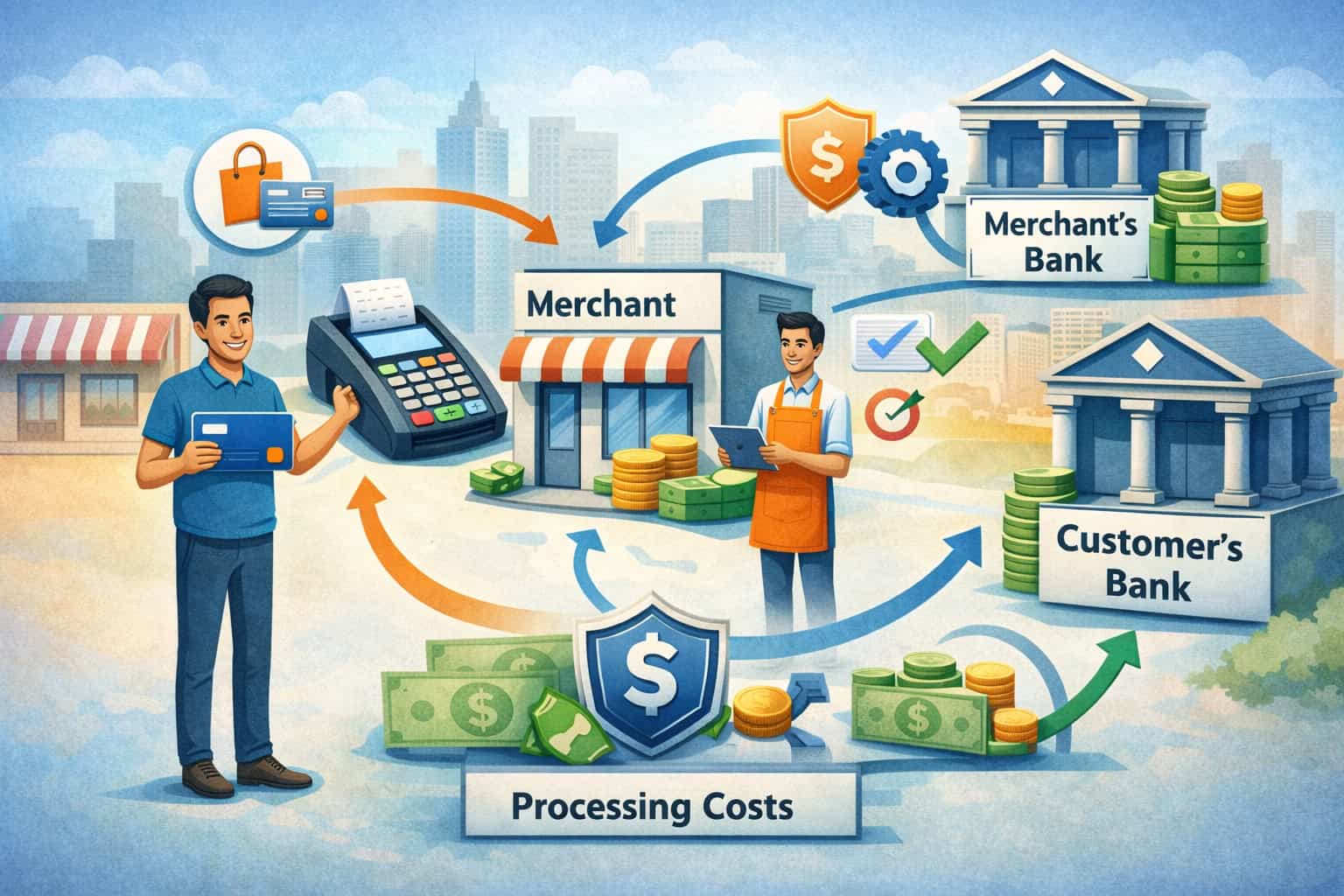
“Lowest-rate merchant services” sounds simple: you pay the least to accept card payments, keep more profit, and move on. In real life, “lowest-rate merchant services” is a pricing claim, not a pricing structure—and the difference matters.
The card ecosystem has built-in costs (like interchange and network assessments) that most providers can’t change. What they can change is the markup, the contract terms, the extra fees, and the way pricing is presented on ads, quotes, and statements.
This guide explains how lowest-rate merchant services actually work in day-to-day processing: what fees are real, what fees are “presentation,” how providers design “lowest rate” offers, and how to verify a true low-cost setup using statement math.
You’ll also learn which pricing models tend to produce the lowest total cost for different business types, how to spot hidden costs, and how the market is likely to evolve as real-time bank payments and network rules keep shifting.
Throughout, the goal is practical: help you choose lowest-rate merchant services that stay low after month one—without getting trapped in a contract or a fee stack.
The Core Truth Behind Lowest-Rate Merchant Services: You Can’t Negotiate Most of the Bill
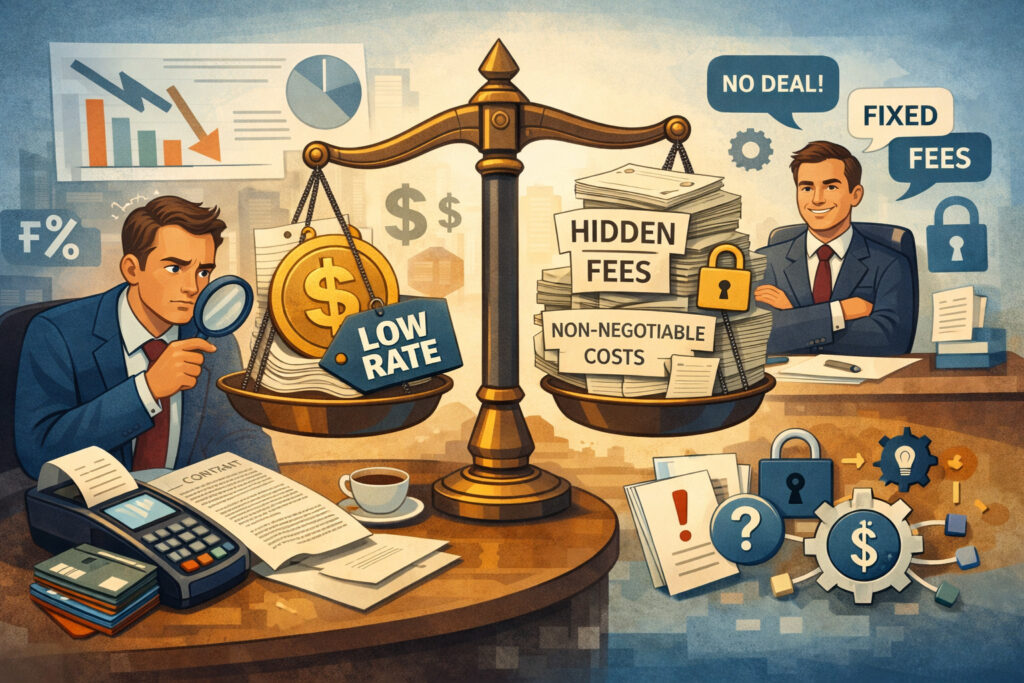
Lowest-rate merchant services are often marketed as if the provider controls “the rate.” In reality, a large portion of every card transaction is non-negotiable because it is set by the card networks and flows through the system automatically.
The biggest piece is typically interchange, which compensates the card-issuing bank for taking credit risk, funding rewards, and running fraud controls. Interchange varies by card type (debit vs credit), how the card is accepted (in-person chip vs online), the merchant category, and data quality (like AVS and security fields).
On top of interchange, there are network assessments (also commonly called dues and assessments) that go to the card networks for operating the rails. Those are also largely fixed. That means the “lowest rate” you see in an ad cannot be the full picture, because no merchant services provider can make interchange disappear.
Lowest-rate merchant services, when done honestly, focus on minimizing the controllable layer: the processor’s markup, unnecessary program fees, and avoidable penalties (like downgrades or non-qualified buckets).
So if you’re trying to evaluate lowest-rate merchant services, the best approach is not “Who promises the smallest percentage?” but “Who offers the cleanest structure, lowest markup, fewest junk fees, and best optimization for how I accept payments?”
When you see it this way, lowest-rate merchant services become a process: align pricing with your transaction mix, keep acceptance clean, and prevent fee creep over time.
What You’re Actually Paying For: Interchange, Assessments, and Markup Explained Clearly
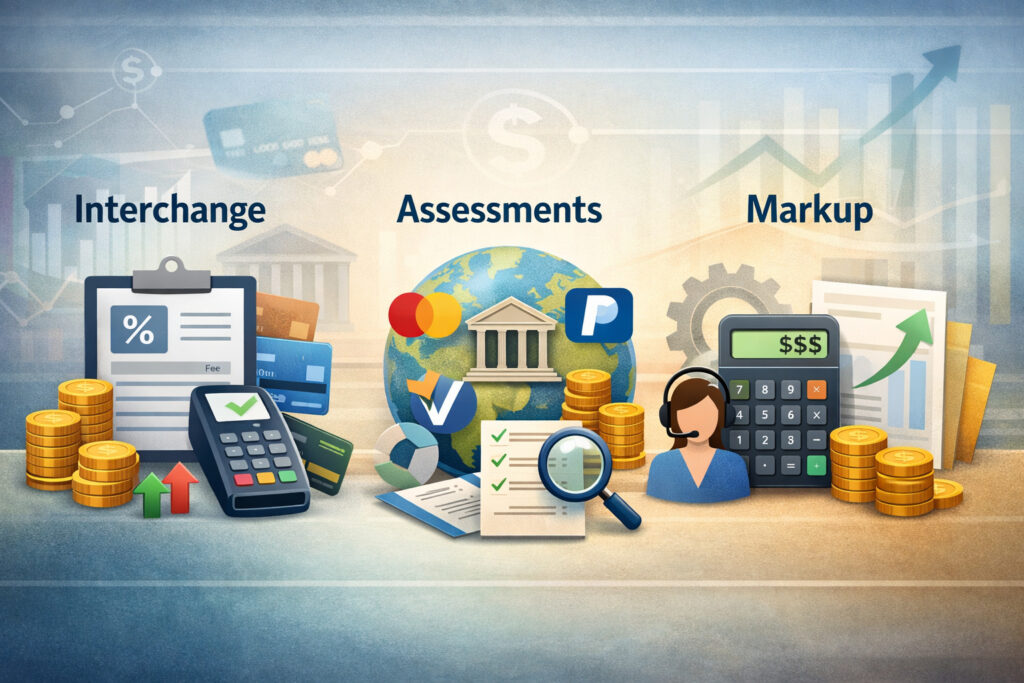
To understand lowest-rate merchant services, you need to separate your processing cost into three layers:
- Interchange (issuer cost): This is the foundational cost and often the largest. It varies constantly by card type and acceptance method. Debit tends to cost less than rewards credit. Regulated debit can be priced differently from unregulated debit depending on the transaction environment. Online transactions usually cost more than in-person because fraud risk is higher.
- Assessments and network fees (network cost): These fees fund the card networks. They can include percentage-based assessments and per-transaction network fees. While people call them “small,” they add up fast if you run lots of tickets.
- Processor markup and program fees (provider cost): This is where lowest-rate merchant services live. Markup might be expressed as basis points and per-item cents, or as tiered buckets, or as a flat rate. Program fees can include monthly minimums, statement fees, PCI program fees, gateway fees, chargeback fees, batch fees, “non-compliance” fees, and more.
The reason “lowest-rate merchant services” is tricky is that providers often advertise a price that describes only the markup (or only a “starting at” scenario) while the rest of the invoice remains hidden until you see the statement.
A reliable lowest-rate merchant services setup is one where the pricing method makes it easy to see interchange and assessments pass through cleanly, while markup stays predictable. If you can’t clearly separate those three layers on a statement, you are usually not seeing truly lowest-rate merchant services—because opacity is where extra profit hides.
Why Advertised “Lowest Rates” Rarely Match Your Effective Rate on Real Statements
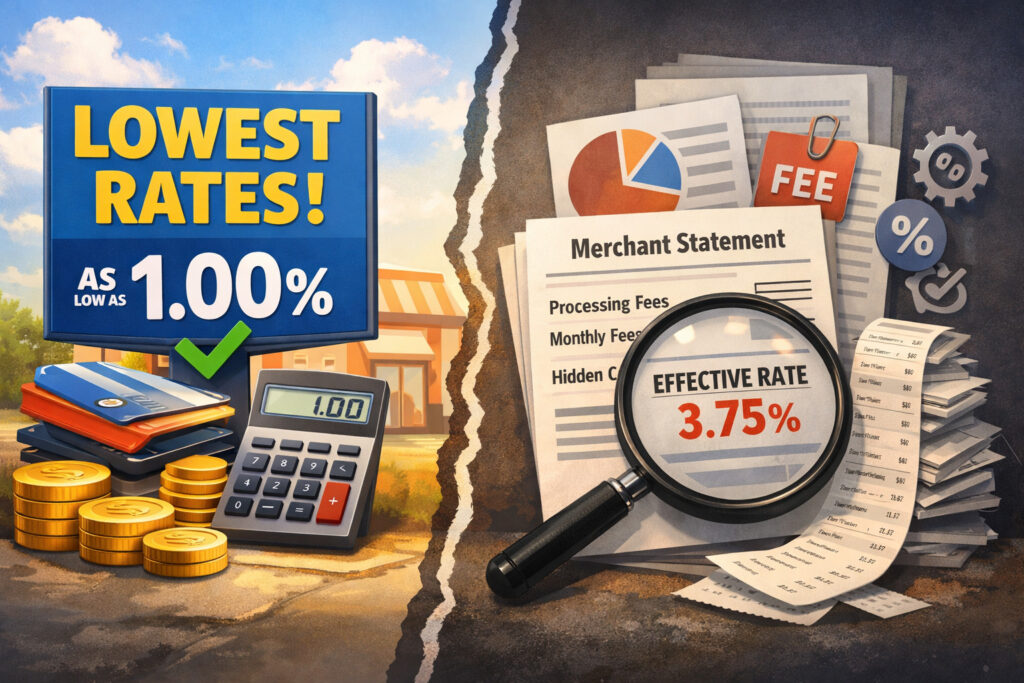
Lowest-rate merchant services ads commonly use a single headline number like “as low as 0.10%” or “2.29% + 10¢” or “no fees.” The problem is that a single number can’t accurately represent a pricing system that changes with card type, acceptance method, and risk.
Your effective rate—your total processing fees divided by total card sales—depends on your transaction mix and fee stack, not the headline.
Here are common reasons the “lowest rate” doesn’t match what you pay:
- Transaction mix mismatch: The headline rate may be based on a basic debit card in-person. If your customers use rewards credit cards, business cards, or you accept online payments, your true cost rises.
- Bundled pricing: Flat-rate pricing is simple, but it bakes in a “spread” that can be higher than interchange-plus for many businesses, especially with larger average tickets.
- Extra program fees: Monthly, annual, PCI, gateway, chargeback, and statement fees can raise your effective rate dramatically—especially for lower-volume merchants.
- Downgrades and data penalties: If your setup doesn’t send the right data fields (often in B2B settings) or your checkout is not optimized, you can pay higher categories.
- Minimums and “compliance” fees: Some contracts use minimums that effectively raise rates if volume is seasonal.
If you want lowest-rate merchant services, you should judge the provider by total monthly cost under your real processing pattern, not a marketing rate.
The most practical method is to take two or three months of statements and compute the effective rate, then compare a quote using those numbers. That’s how lowest-rate merchant services become measurable instead of promotional.
The Pricing Models That Determine Whether You Truly Get Lowest-Rate Merchant Services
Interchange-Plus Pricing (Often the Benchmark for Lowest-Rate Merchant Services)
Interchange-plus (also called cost-plus) is frequently the cleanest structure for lowest-rate merchant services because it separates the non-negotiable costs from the provider markup.
You pay actual interchange + actual assessments + a transparent markup (for example, “X basis points + Y cents per transaction”). This makes it easier to audit statements and prevents providers from quietly widening margins inside “qualified / mid-qualified / non-qualified” buckets.
Interchange-plus tends to be strong for businesses with steady volume, reasonable ticket sizes, and a mix that includes rewards cards.
It’s also commonly preferred when you want the lowest-rate merchant services outcome over time, because you can see if costs rise due to card mix (which you can’t control) versus markup changes (which you can). That transparency is powerful: it makes renegotiation and provider comparisons fair.
However, interchange-plus still needs discipline. Lowest-rate merchant services under interchange-plus is not only about a low markup; it’s also about controlling fee creep (gateway, PCI, support packages), optimizing acceptance (chip, tokenization, AVS), and avoiding unnecessary add-ons.
A provider can offer interchange-plus and still be expensive if they stack program fees. So for lowest-rate merchant services, treat interchange-plus as the pricing foundation, then interrogate the rest of the fee schedule.
Flat-Rate Pricing (Simple, Predictable, Sometimes Not Lowest-Rate Merchant Services)
Flat-rate pricing charges the same percentage (and often a per-transaction fee) for most card types. It can be attractive for startups because it’s simple, easy to budget, and often has fewer line items.
For certain micro-merchants, seasonal sellers, or businesses with very small ticket sizes, flat-rate can be “good enough” even if it’s not truly lowest-rate merchant services by strict math.
But flat-rate pricing works by averaging costs. If your customers use a lot of debit or basic cards, you may overpay. If your average ticket is high, the spread can get expensive. And if you grow, flat-rate often becomes the “growth tax” you forget to revisit.
True lowest-rate merchant services for a scaling business frequently shift away from flat-rate as volume increases and as you start caring about basis points.
If you choose flat-rate, the best lowest-rate merchant services approach is to evaluate total fees at your current volume and set a review trigger: for example, when you cross a certain monthly card volume or average ticket threshold, re-price into interchange-plus. Flat-rate is not “bad,” but it’s not automatically lowest-rate merchant services—especially long term.
The Hidden Fee Stack That Can Destroy Lowest-Rate Merchant Services Even With a Low Markup
Lowest-rate merchant services can be won or lost in the fee schedule. Many businesses obsess over the rate and ignore the monthly and per-event fees that quietly inflate total cost. The most common culprits include:
- Monthly minimums: If your volume drops, you “make up” fees to reach a minimum. This can spike effective cost for seasonal businesses.
- Statement fees and account fees: Small monthly line items that add up.
- Gateway and platform fees: Especially for online payments. You may pay a monthly gateway fee, plus per-transaction gateway fees, plus tokenization or vault fees.
- PCI program and non-compliance fees: Some providers charge monthly PCI fees and then charge large monthly penalties if you don’t complete steps on time. Lowest-rate merchant services require understanding how compliance is handled and what “non-compliance” actually costs.
- Batch fees: Charged when you close the day and settle transactions. For high-frequency batching or certain setups, this adds cost.
- Customer support packages: Some contracts bundle “support” as paid tiers.
- Chargeback and retrieval fees: Not frequent for all merchants, but they can be expensive when disputes rise.
The reality is that lowest-rate merchant services is not a single number; it’s an ecosystem of costs. A provider can advertise “lowest-rate merchant services” while charging more than competitors by stacking fees in places you don’t compare.
The fix is to demand a full fee schedule and evaluate your expected monthly fee footprint based on your transaction count, your channels (in-person vs online), and your risk profile.
Tiered Pricing: The Classic “Lowest-Rate Merchant Services” Trap and How It Works
Tiered pricing sorts transactions into buckets often labeled “qualified,” “mid-qualified,” and “non-qualified.” The provider advertises a very low “qualified” rate, which makes it look like lowest-rate merchant services.
But many real-world transactions do not land in the cheapest bucket—especially rewards cards, keyed transactions, online payments, business cards, or any transaction with missing data.
The key issue is control and visibility. The provider decides which transactions qualify, and the rules are often not transparent. Two merchants with identical card mix could pay different totals based on how the provider classifies transactions.
That makes it difficult to audit whether you truly got lowest-rate merchant services, because the provider’s margin is baked into the bucket spread.
Tiered pricing sometimes includes extra surcharges like “non-qualified add-ons” or “downgrade fees” that are hard to predict. Many merchants only discover the truth after receiving statements showing a high portion of sales priced at expensive tiers. The effective rate ends up far above the headline “lowest” rate.
If you’re offered tiered pricing and you want lowest-rate merchant services, the safest move is to request an interchange-plus alternative and compare both using your real statements. If the provider refuses, that’s often a sign the “lowest-rate merchant services” claim relies on opacity.
The Quote Game: How Providers Make Lowest-Rate Merchant Services Look Cheaper Than It Is
Lowest-rate merchant services providers (or sales agents) can “win” a quote comparison by changing what’s included. Common tactics include:
- Quoting markup only: Leaving interchange and assessments unspoken, even though you’ll pay them.
- Quoting one channel: For example, quoting card-present but not including e-commerce rates or keyed entry.
- Ignoring program fees: Omitting gateway fees, monthly fees, PCI fees, or annual fees from the “rate.”
- Short-term promotions: Offering a teaser rate for a few months, then re-pricing later.
- Bundling equipment: Offering “free” equipment but recovering cost through higher processing fees or lease agreements.
True lowest-rate merchant services comparisons require a standardized method: take your monthly sales, transaction count, card-present vs online mix, average ticket, and top fee categories, then model total cost under each quote. If you don’t do that, you’re comparing marketing, not math.
Underwriting and Risk: Why Your Business Type Changes the Lowest-Rate Merchant Services Outcome
Lowest-rate merchant services depend heavily on risk. Providers price risk through reserves, delayed funding, higher markups, stricter chargeback terms, or even sudden account closures if underwriting wasn’t done properly.
That’s why a “lowest-rate” offer that ignores risk realities can be dangerous: you might get a cheap quote and then face holds or termination later.
Risk is evaluated using factors like:
- Business model (in-person retail vs online subscription)
- Ticket size and refund patterns
- Chargeback history
- Time from purchase to fulfillment
- Customer location patterns
- Marketing practices and claim language
- Product categories and regulatory considerations
Lowest-rate merchant services for a low-risk business is often about shaving basis points and reducing junk fees. Lowest-rate merchant services for a higher-risk profile is often about stability—a fair price with predictable funding and clear rules. The cheapest quote can be the most fragile account if the provider tries to onboard quickly without proper underwriting.
A strong provider will ask detailed questions early, request documentation when needed, and set expectations. That’s not “bad”—it’s how lowest-rate merchant services stay functional. The best low-cost setup is the one that doesn’t blow up when volume spikes or disputes rise.
Payment Acceptance Choices That Directly Control Your Costs
Lowest-rate merchant services aren’t only about negotiating. It’s also about how you accept payments, because the acceptance method changes both cost and fraud risk.
- Chip (EMV) in-person generally reduces fraud exposure compared to swiped magstripe and supports lower risk handling.
- Contactless can increase speed and reduce friction while keeping security strong.
- Keyed entry is typically more expensive and riskier than chip because it’s easier to misuse and harder to validate.
- Online transactions often cost more due to higher fraud and chargeback rates, which influences pricing and monitoring.
Operational choices also matter. Using address verification (AVS) and security codes (CVV) for online transactions can reduce fraud and improve approvals.
Tokenization and account updater tools can reduce failed recurring payments and prevent involuntary churn—helpful for subscription businesses aiming for lowest-rate merchant services outcomes through fewer chargebacks and retries.
Your provider should help you align acceptance methods with cost control. When lowest-rate merchant services are real, it includes practical optimization: the checkout flow, fraud tools, and settlement practices that reduce the “risk tax” you pay indirectly.
Contracts and Terms That Decide Whether Your “Lowest Rate” Stays Low
Lowest-rate merchant services should be evaluated over time, not at signup. Contract terms often determine whether your price creeps up:
- Term length and auto-renewal: Some agreements renew automatically with limited cancellation windows.
- Early termination fees (ETFs): Can trap you in a bad deal.
- Rate reclassification clauses: Allow providers to change pricing if they claim your “risk profile” changed.
- Pass-through fee clauses: Some contracts pass new network fees automatically (which can be legitimate) but may also introduce vague “program” fees.
- Equipment leases: Often non-cancelable and expensive over time.
For lowest-rate merchant services, you want simple terms: transparent pricing, clear cancellation rules, minimal penalty exposure, and equipment you own or can switch easily. If you can’t leave, you can’t enforce “lowest-rate merchant services” through competition.
A good approach is to treat the agreement as part of pricing. A slightly higher markup with clean terms can be cheaper than a “lowest-rate” teaser tied to penalties, price hikes, or locked hardware. Lowest-rate merchant services are about total cost and leverage.
How to Audit a Statement to Prove You’re Actually Getting Lowest-Rate Merchant Services
The most reliable way to verify lowest-rate merchant services is statement analysis. Here’s a practical approach:
- Calculate effective rate: Total fees / total card sales. Do this for several months to see stability.
- Separate pass-through vs markup: Identify interchange and network fees versus processor markup and program fees. In interchange-plus, this should be clear.
- Check per-item costs: If you have many small tickets, per-transaction cents can matter as much as basis points.
- Find fee creep: Compare month to month for new “account” fees, “regulatory” fees, “program” fees, or “support” fees that appear without explanation.
- Identify downgrades and higher-cost categories: If a large portion of volume hits expensive categories, look for causes (keyed entry, missing data, online mix, fraud settings).
Lowest-rate merchant services should show a predictable relationship: when card mix shifts toward rewards credit, costs rise proportionally; when volume increases, your effective rate should not rise due to new fixed fees. If you see costs rising without mix changes, that’s a warning.
The best providers will help you interpret statements and recommend optimizations. If your provider resists transparency, you’re probably not in a true lowest-rate merchant services relationship.
Negotiation That Works: What You Can Ask for (And What You Usually Can’t)
Lowest-rate merchant services negotiation is most effective when you focus on what’s negotiable:
Often negotiable:
- Processor markup (basis points and per-item cents)
- Monthly account fees
- PCI program fees and penalty structures
- Gateway fees (sometimes)
- Chargeback fees (sometimes)
- Annual fees (often removable)
- Contract length and termination terms
Usually not negotiable:
- Interchange categories (set by the network/issuer system)
- Most network assessments
- Some pass-through network fees that apply broadly
The best negotiation tool is data: your monthly volume, average ticket, chargeback ratio, and your current effective rate. If you can show stable processing and low risk, you can often secure lowest-rate merchant services pricing that stays competitive.
Also, negotiate guardrails: insist on written pricing schedules, limits on fee additions, and clear cancellation terms. Lowest-rate merchant services is as much about preventing future increases as it is about lowering today’s markup.
Realistic “Lowest-Rate Merchant Services” by Business Type
Lowest-rate merchant services vary by business model because cost drivers vary.
- Retail with chip transactions: Often benefits from interchange-plus with low markup, minimal gateway costs, and optimized batching.
- Restaurants and quick-service: Per-item fees matter because transaction counts are high; hardware reliability and fast funding matter too.
- Professional services: Often have larger tickets and occasional keyed entry; policies around card-not-present verification become important.
- E-commerce: Gateway and fraud stack matters; authorization, retries, tokenization, and dispute tooling can be the difference between low and high costs.
- Subscription businesses: Account updater and dunning tools reduce declines and chargebacks, lowering the “hidden” costs of churn and disputes.
The key is that lowest-rate merchant services isn’t one universal package. The lowest-cost setup is the one tuned to your ticket size, channel mix, and risk realities—with pricing that matches that reality. A generic “lowest-rate merchant services” ad can’t account for your mix, which is why statement-based evaluation wins.
The “Zero-Fee” and Surcharge Strategies: When They Help and When They Backfire
Some offer lowest-rate merchant services through “zero-fee” processing, cash discounting, or surcharging. These programs can shift some costs to customers, but they must be handled carefully.
Surcharging rules vary by card network and local regulations, and compliance requirements (like signage, receipt language, and caps) matter.
Cash discount programs can be structured differently than surcharging and can still create customer friction if implemented poorly. The operational reality is that customers may abandon checkout, complain, or dispute charges if the pricing feels unclear.
Lowest-rate merchant services via surcharge strategy can work best when:
- Your market tolerates it
- You implement it transparently
- Your pricing and receipts are consistent
- You understand compliance and disclosure rules
It can backfire when it increases disputes, damages brand trust, or triggers higher chargeback ratios (which then increases risk pricing and monitoring).
If disputes rise, your “lowest-rate merchant services” plan can become more expensive overall due to chargeback fees and reserve policies. The best approach is to model the upside and the risk cost, not just the advertised “zero-fee” claim.
Security, Compliance, and Fraud Controls That Protect Your Rates Long-Term
Lowest-rate merchant services isn’t only about pricing; it’s also about keeping fraud and disputes low enough that your provider doesn’t reprice you, hold funds, or terminate the account. Good security practices reduce total cost indirectly.
Key elements include:
- PCI scope reduction using hosted fields or tokenization
- Point-to-point encryption (P2PE) for many in-person setups
- 3DS for certain online transactions when it improves fraud outcomes
- AVS/CVV checks tuned to reduce fraud without killing approvals
- Chargeback alerts and representment tools when disputes are common
- Clear refund and customer service workflows to prevent disputes
When you reduce fraud and chargebacks, you reduce both direct fees (chargeback fees, lost revenue) and indirect pricing pressure (risk-based markups, reserves). That’s why lowest-rate merchant services should include a plan for dispute management and fraud prevention, not just a low quote.
If a provider claims lowest-rate merchant services but offers weak tooling, you may pay later in losses and operational chaos. A slightly higher markup with strong controls can be cheaper than a barebones setup that triggers disputes.
Future Predictions: Where Lowest-Rate Merchant Services Is Headed Next
The next phase of lowest-rate merchant services is likely to be shaped by three forces:
- More bank-to-bank real-time options: As real-time payment rails expand, some merchants will steer certain payments away from cards for cost reasons—especially invoices, B2B flows, and high-ticket transactions. This won’t kill cards, but it can reduce card dependence in certain segments.
- Tighter fraud ecosystems: Fraud patterns keep evolving, and networks continue to adjust liability and security expectations. Merchants who adopt stronger authentication, better tokenization, and smarter risk controls may see more stable approvals and fewer disputes—supporting lower long-term total cost.
- Pricing transparency pressure: Businesses are more educated now. Providers who rely on opaque tiered pricing and fee stacks face stronger churn. That market pressure should increase adoption of clearer interchange-plus pricing for merchants seeking lowest-rate merchant services, especially at higher volumes.
Even with these changes, interchange and network fees will remain core in card processing. So the future of lowest-rate merchant services still comes back to fundamentals: transparent markup, minimal junk fees, optimized acceptance, and operational discipline.
Providers that combine clean pricing with modern tooling will define what “lowest-rate merchant services” means over the next few years.
FAQs
Q.1: What does “lowest-rate merchant services” really mean?
Answer: Lowest-rate merchant services should mean the lowest total cost for your real transaction mix, not the lowest advertised percentage. A true lowest-rate merchant services provider offers transparent pricing, minimal extra fees, and tools that reduce disputes and inefficiencies.
If you only compare headline rates, you can end up paying more once monthly fees, gateway costs, and transaction mix effects appear on statements. The most accurate definition of lowest-rate merchant services is “the lowest sustainable effective rate with stable funding and transparent terms.”
Q.2: Is interchange-plus always the best lowest-rate merchant services option?
Answer: Interchange-plus is often the most transparent path to lowest-rate merchant services, but not always the cheapest for every situation. Very small sellers may prefer flat-rate simplicity. Seasonal sellers may prefer minimal monthly fees.
Some high-ticket, low-transaction businesses care more about basis points than per-item fees. The best lowest-rate merchant services choice depends on volume, ticket size, and how payments are accepted.
Q.3: How can I tell if my provider is adding hidden fees?
Answer: Look for fee creep: new monthly charges, “program” fees, “regulatory” fees, PCI penalties, and rising effective rates without a change in sales mix.
If your statement can’t clearly separate interchange, assessments, and markup, your provider may be hiding margin. Lowest-rate merchant services should be auditable, and a provider should be willing to explain every recurring fee in plain language.
Q.4: Can I negotiate lowest-rate merchant services if I’m a new business?
Answer: Yes, but leverage is different. New businesses can often negotiate contract terms, avoid long commitments, and reduce unnecessary monthly fees. Markup might be slightly higher until processing history is established.
The smartest way to get lowest-rate merchant services early is to choose transparent pricing, keep your risk profile clean, and plan a repricing review after several stable months.
Q.5: Do “zero-fee” programs guarantee lowest-rate merchant services?
Answer: Not automatically. They shift costs but can increase disputes and customer friction if implemented poorly. They also have compliance and disclosure requirements.
For some businesses, these programs reduce net cost; for others, they increase total cost through lost sales, complaints, and chargeback fees. Lowest-rate merchant services must be evaluated by total outcome, not marketing labels.
Conclusion
Lowest-rate merchant services is not a magic number—it’s a system you can measure, negotiate, and optimize. The non-negotiable costs are baked into card payments, so the real “lowest-rate merchant services” win happens in the controllable layer: transparent markup, minimal fee stacking, strong terms, and operational practices that reduce disputes and inefficiencies.
If you want lowest-rate merchant services that stay low, treat it like an ongoing audit. Compare providers using your real statements. Calculate effective rate. Identify hidden fees. Prefer pricing models that separate pass-through costs from markup.
Choose terms that let you leave if pricing creeps up. And don’t ignore security, fraud, and dispute controls—because they influence your total cost as much as a few basis points.