
Accepting cards helps businesses get paid faster, close more sales, and make checkout easier for customers. But many merchants discover too late that the advertised rate was only part of the story.
The real problem is not always the obvious credit card processing fees. It is the extra layer of charges buried in statements, contracts, equipment agreements, and vague pricing categories.
These Hidden Fees in Credit Card Processing can quietly eat into profit month after month, especially when a business is busy and no one has time to review every line item.
Some fees are legitimate. Interchange fees, assessments, chargebacks tied to real disputes, and clearly disclosed gateway costs can all be part of normal payment acceptance.
The trouble starts when merchant services pricing becomes hard to audit, poorly explained, or padded with charges that add little or no real value. That is where Credit Card Processing Hidden Costs turn into a profit leak.
If you are trying to lower payment processing costs, this guide will help you separate normal expenses from Merchant Account Hidden Fees that should be challenged, negotiated, or avoided altogether. You will learn which five costs deserve the most scrutiny, how to compare pricing models, how to calculate your effective rate, and how to Avoid Hidden Merchant Fees before they turn into a long-term problem.
A lot of merchants focus only on the percentage rate. That is understandable, but it is rarely enough. A provider can advertise an attractive rate and still make the overall account expensive through monthly fees, batch fees, annual fees, PCI compliance fees, payment gateway fees, non-qualified surcharges, and restrictive contract terms. That is why a full merchant statement review matters more than a teaser quote.
For a broader look at where card acceptance costs really come from, the guide on the true cost of accepting cards is a helpful companion read. It reinforces an important point: the visible rate is only one part of the total cost of processing.
What hidden fees in credit card processing actually are
Hidden fees are charges that a merchant either did not expect, did not clearly agree to, or could not easily understand from the sales conversation alone. They are not always illegal or impossible to find in the paperwork.
In many cases, they are technically disclosed somewhere in the agreement, but only in a way that most business owners would never catch during a rushed signup.
That is what makes them so frustrating. The processor may say the fee was “in the contract,” while the merchant is left asking why it was never clearly explained upfront. This is common with statement fees, annual fees, PCI compliance charges, monthly minimums, gateway markups, equipment lease fees, and early termination penalties.
Another reason these charges go unnoticed is that many statements are designed to be hard to audit. Line items are abbreviated, categories are lumped together, and markup is blended with wholesale costs.
In opaque pricing structures, especially tiered pricing, it can be difficult to tell whether you are paying the true interchange fees plus a fair processor markup or a padded rate with hidden processor fees mixed in.
Industry guidance consistently describes interchange-plus as more transparent and tiered pricing as harder to audit, which is why experienced merchants often prefer clearer pricing models.
Legitimate costs vs. avoidable hidden processor fees
Not every line on your statement is a scam. Businesses should expect some real payment processing costs. The key is understanding which ones are unavoidable and which ones are optional, inflated, or duplicated.
Legitimate costs often include:
- Interchange fees tied to card type and transaction method
- Network assessments
- A clearly disclosed processor markup
- Real chargeback fees when an actual dispute happens
- A reasonable payment gateway fee when special gateway functionality is required
- Hardware costs when you choose to buy equipment outright
Avoidable or questionable fees often include:
- Junk statement fees that do not match any real service
- Inflated PCI compliance fees
- Annual fees with no clear benefit
- Excessive monthly minimums for low-volume merchants
- Non-cancellable equipment lease fees
- Early termination or cancellation fees
- Non-qualified surcharges under murky tiered pricing
- Setup fees for standard onboarding
- Duplicate gateway or platform fees
The difference matters because many merchants assume all fees are standard. They are not. A fair provider should be able to explain every line item in a sentence or two and show which charges are pass-through costs versus processor markup. If they cannot do that, the pricing probably needs a closer look.
Why so many businesses overpay without realizing it
Businesses rarely overpay because they are careless. More often, they overpay because payment processing is sold in a way that directs attention to the wrong numbers.
The classic example is the teaser rate. A salesperson highlights a low “qualified” rate or a flat promotional figure that sounds great in conversation.
What does not get equal attention are the monthly fees, the annual fees, the batch fees, the PCI charge, the gateway markup, the non-qualified downgrade categories, the monthly minimum, or the contract language that makes leaving expensive.
That is why businesses across retail, eCommerce, service, recurring billing, and keyed-in environments can all end up paying more than expected. The fee problem changes shape depending on the business model, but the pattern is similar: the quote looks simple, the statement does not.
Retail merchants may get hit with equipment lease fees and batch fees.
eCommerce merchants may see payment gateway fees, tokenization add-ons, and fraud-tool markups.
Service businesses may pay more on keyed-in transactions and then get pushed into tiered pricing buckets that are hard to verify. Recurring billing businesses may carry multiple layers of software and gateway costs on top of processing.
Common sales tactics that hide the real price
A provider does not have to lie to make an offer look cheaper than it really is. Often, the real cost is hidden by omission, packaging, or confusing terminology.
Watch for tactics like these:
- Leading with a low headline rate while avoiding a full fee schedule
- Using vague labels such as “regulatory fee,” “network access,” or “service package”
- Quoting only percentage pricing while skipping per-transaction charges
- Presenting tiered pricing without defining qualified, mid-qualified, and non-qualified categories
- Bundling hardware into a long lease instead of offering a purchase option
- Describing fees as “standard” without explaining whether they are negotiable
- Calling a long-term contract “month to month” while a separate equipment or gateway agreement locks you in
- Promising savings without reviewing an actual merchant statement
A more transparent way to compare offers is to understand how merchant account pricing works before you focus on rate alone. The article on merchant services pricing models can help you see why the pricing structure matters as much as the price itself.
Cost #1 you should never pay: junk monthly and annual account fees
One of the most common Hidden Fees in Credit Card Processing is the collection of recurring account charges that add little real value. These are the quiet monthly and annual fees that often slip by because they look small on paper.
A statement fee may be only a few dollars. An annual fee may appear only once. A monthly minimum may not seem like a big deal during slow periods. But together, these Merchant Account Hidden Fees can turn a seemingly affordable account into a costly one.
This category often includes:
- Statement fees
- Paper statement fees
- Annual fees
- Monthly minimums
- Account maintenance fees
- Customer service or support fees
- Platform access fees with no distinct platform value
Some recurring fees can be reasonable when they pay for something specific and useful. But many are leftovers from older pricing models or margin add-ons that merchants simply accept because they assume they are universal. They are not.
Statement fees, annual fees, and monthly minimums that deserve pushback
A statement fee is one of the easiest charges to challenge. If your statement is digital, auto-generated, and accessible through a portal, there should be a clear reason for the fee. If there is no paper mailing, no custom reporting, and no premium support attached to it, ask what you are actually paying for.
Annual fees raise a similar issue. Some providers still charge them as a routine account fee, even though they provide no extra service at the renewal point. If the annual fee does not include something valuable and clearly defined, it is often just another markup layer.
Monthly minimums are especially frustrating for seasonal businesses, startups, and merchants with uneven volume. These fees punish low-sales periods rather than rewarding growth. In practice, they can make a low-volume account much more expensive than it looks on the quote sheet.
Here is a simple comparison of fair fees versus questionable hidden fees:
| Fee Type | Usually Fair When… | Usually a Hidden or Questionable Fee When… |
| Statement fee | It funds special reporting or custom account support | It is charged on a basic digital statement with no added value |
| Annual fee | It includes a clearly defined annual service | It appears automatically with no meaningful benefit |
| Monthly minimum | It is clearly disclosed and fits a custom plan | It punishes low-volume or seasonal merchants without warning |
| Account maintenance fee | It covers a real managed service | It is vague, recurring, and poorly explained |
| Paper statement fee | You requested mailed statements | You only use online reporting |
Pro Tip: Ask the provider to waive statement fees, annual fees, and monthly minimums before you sign. If they say the fees are “standard,” ask whether they are standard for all accounts or just standard because most merchants do not push back.
For merchants comparing options, content on how to get the lowest credit card processing fees and low fee payment processing reinforces the same theme: markup and extra service fees often matter more than the headline rate when trying to cut total costs.
Cost #2 you should never pay: inflated PCI compliance fees and duplicate security charges
PCI compliance is real. Protecting cardholder data matters. Most businesses understand that. But PCI compliance fees are also one of the easiest places for hidden processor fees to show up.
Some providers charge a modest, clearly explained compliance fee tied to support, validation tools, or security scanning. Others use “PCI” as a catch-all label for charges that are inflated, duplicated, or disconnected from the actual help being provided. That is where the fee crosses from legitimate to questionable.
A merchant may be billed for PCI compliance monthly, then billed another annual PCI fee, then charged a non-compliance penalty if paperwork was not completed, even though the provider never offered meaningful support.
In some cases, merchants are charged for basic security tasks that are already built into the gateway, terminal, or platform they are paying for elsewhere.
How to tell whether a PCI fee is reasonable or padded
Start with the service behind the charge. Ask what the PCI fee includes. Is there a portal, validation support, scanning assistance, breach protection service, or educational guidance? Or is it just a line item with no practical benefit to the merchant?
Then look for duplication. If you already pay a payment gateway fee, a platform fee, or a managed security bundle, find out whether PCI tools are already included there. A second PCI charge may simply be layered markup.
Also review the fee timing. A provider that charges a monthly PCI fee and a separate annual PCI fee should be able to explain why both exist. If they cannot, that is a red flag.
Questions to ask include:
- What exactly does this PCI compliance fee cover?
- Is there also an annual PCI fee?
- What happens if I am already compliant through my software or gateway?
- Is there a non-compliance fee, and how can I avoid it?
- Are any security tools included elsewhere in my account?
Security and compliance are real parts of merchant services, but they should be transparent and tied to actual support. General merchant-services guidance on Lowest Rate Merchant Services also emphasizes checking security and compliance as part of provider evaluation, not as a blank check for unclear charges.
Cost #3 you should never pay: non-cancellable equipment lease fees
If there is one fee category that frustrates merchants more than almost any other, it is equipment leasing. Not because hardware itself is unreasonable, but because the lease structure is often where payment processors make expensive deals look harmless.
A terminal that could be purchased for a modest one-time amount may instead be wrapped into a long non-cancellable lease with a much higher total cost over time. By the end of the agreement, the merchant may have paid several times the actual value of the device and still face penalties for ending early.
This is one of the most damaging Credit Card Processing Hidden Costs because it sits outside the advertised processing rate. A business owner thinks they are agreeing to card acceptance, but they are also locking into a separate equipment obligation with its own terms, payment schedule, and cancellation rules.
The problem is not renting equipment in general. Renting can be reasonable for certain businesses that need flexibility, quick replacement, or bundled support. The problem is the non-cancellable lease that turns a simple terminal into a long-term financial trap.
Why buying hardware is often safer than leasing it
When merchants buy equipment outright, the cost is visible. They can compare terminal models, weigh the features, and see the true ownership cost. There is no mystery about the total amount paid.
With a long-term lease, the math gets blurry. The monthly amount may look manageable, but the total paid over the full term can be far higher than the actual hardware value. On top of that, the equipment may become outdated long before the lease ends.
Leases also create exit friction. Even if the processing agreement ends, the equipment lease may continue. This catches many merchants off guard. They cancel the merchant account and assume the account is closed, only to find that the terminal lease is separate and still enforceable.
Before agreeing to any equipment arrangement, ask:
- What is the total cost of the equipment if I buy it outright?
- What is the total cost over the full lease term?
- Is the lease cancellable?
- Is the lease separate from the processing agreement?
- Who services or replaces the equipment if it fails?
- What happens if I switch processors?
Guidance on processing cost control from Lowest Rate Merchant Services also notes that long contracts and equipment leases can erase the savings merchants think they are getting from low transaction pricing.
Cost #4 you should never pay: early termination and cancellation fees
A provider that is confident in its pricing and service should not need to trap merchants in a painful exit. Yet early termination fees and cancellation fees remain common, especially in accounts sold through aggressive sales channels.
These charges matter because they distort the buying decision. A provider may quote an attractive rate, count on the merchant signing quickly, and then rely on contract friction to prevent the merchant from switching once the real costs become clear. In that sense, early termination fees are not just a contract issue. They are part of the hidden-fee strategy.
The fee can appear in different forms:
- A flat early termination fee
- Liquidated damages based on projected future revenue
- A cancellation fee hidden in service terms
- Separate gateway cancellation fees
- Separate equipment lease penalties
Any of these can turn a bad pricing relationship into a costly problem. The merchant sees unnecessary fees on the statement, wants to leave, and discovers that leaving costs almost as much as staying.
The contract terms that merchants overlook most often
Many merchants focus on the application and the rate quote, but the most important risk may be buried in the terms and conditions. That is where contract length, auto-renewal language, notice requirements, and termination formulas are usually found.
Auto-renewal is a major one. A contract may seem short, but if it renews automatically unless written notice is given within a narrow window, the account can continue longer than expected. Notice terms are another trap. A merchant may think a phone call is enough, only to learn that cancellation required written notice to a specific address.
Liquidated damages deserve especially close review. This language can allow a provider to charge the estimated profit they expected to earn for the rest of the contract term. That can be far more expensive than a simple flat cancellation fee.
Before signing, ask:
- Is this truly month to month?
- Is there any early termination fee?
- Does the account auto-renew?
- What written notice is required to cancel?
- Are gateway and equipment agreements separate?
- Are there liquidated damages?
Cost #5 you should never pay: vague surcharge categories, non-qualified tiers, and bloated gateway or batch markups
The fifth category is broad, but it belongs together because the same issue runs through all of it: unclear pricing logic. When a provider uses vague categories or layered transaction fees that are hard to verify, merchants lose the ability to tell whether they are paying fair merchant account pricing or hidden markup.
This is where non-qualified surcharges, tiered pricing, gateway markups, and excessive batch fees show up. The merchant may see transactions pushed into expensive buckets without understanding why.
They may pay a payment gateway fee on top of a gateway markup. They may pay batch fees that add up across daily closes without receiving any real operational benefit.
For many businesses, this is the biggest source of ongoing overpayment because it affects every processing day, not just a monthly or annual billing event.
Why non-qualified surcharges and tiered pricing are so hard to audit
Tiered pricing groups transactions into categories such as qualified, mid-qualified, and non-qualified. The challenge is that the processor often controls how those categories are defined within the contract. As a result, the merchant may have no easy way to verify whether a transaction truly belonged in the more expensive bucket.
That makes non-qualified surcharges one of the most frustrating Merchant Account Hidden Fees. The merchant sees the cost rise but cannot see the true underlying interchange and processor markup separately. Industry educational resources widely describe interchange-plus pricing as more transparent because it separates interchange from markup, while tiered pricing often obscures the real cost.
A few pricing models compared:
| Pricing Model | How It Works | Pros | Risks |
| Interchange-plus pricing | True interchange fees plus a separate processor markup | Transparent, easier processing fee comparison, easier to negotiate | Requires statement review and some fee literacy |
| Flat-rate pricing | One bundled rate for transactions | Simple, predictable for some businesses, easy setup | May cost more if your card mix is low-risk or mostly debit |
| Tiered pricing | Transactions fall into qualified, mid-qualified, or non-qualified buckets | Simple sales pitch | Hard to audit, downgrade risk, non-qualified surcharges can inflate costs |
The best model depends on the business. Flat-rate pricing can make sense when simplicity matters and volume is lower. Interchange-plus pricing is often better when a business wants fee transparency and clearer markup control.
Tiered pricing is usually the toughest to analyze and the easiest place for hidden processor fees to hide. Educational material on Lowest Rate Merchant Services makes this same distinction, especially around interchange-plus transparency and tiered pricing opacity.
Gateway fees, batch fees, and add-on transaction costs that deserve a second look
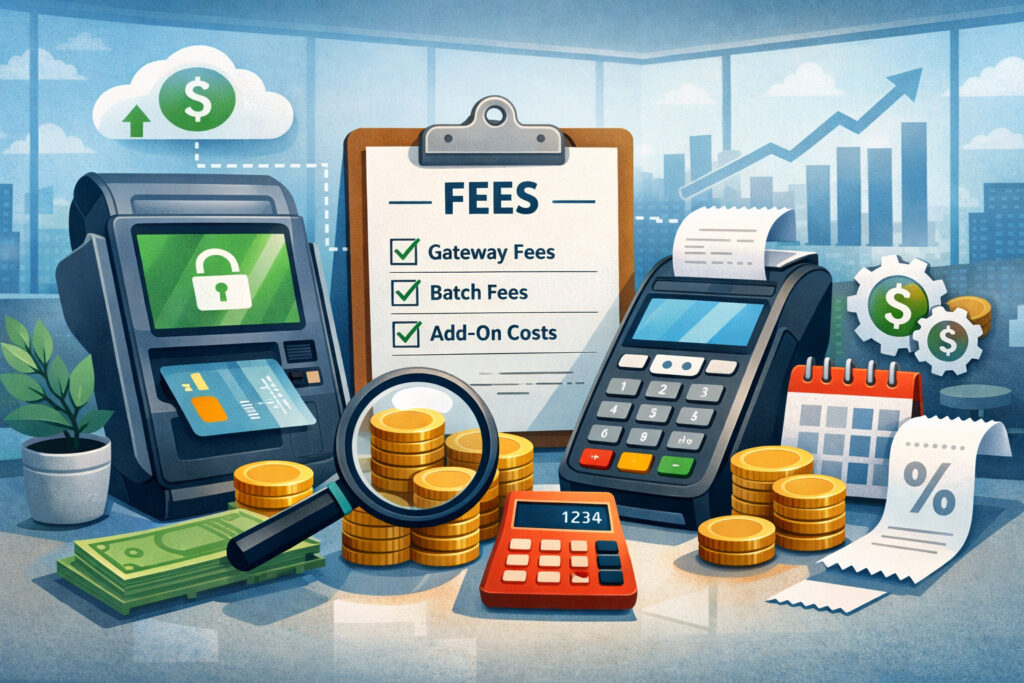
A payment gateway fee is not automatically a bad fee. Some gateways offer valuable tools for online checkout, tokenization, recurring billing, virtual terminal access, fraud settings, and integration support. If you need those features, paying for them can be reasonable.
But gateway pricing becomes a problem when the merchant is charged in multiple layers. For example, a business may pay:
- A monthly gateway fee
- A per-transaction gateway fee
- A platform access fee
- A separate tokenization fee
- A separate recurring billing fee
That may still be acceptable if each feature is necessary and clearly explained. The issue is when these charges are stacked without clarity or bundled into vague software terms.
Batch fees also deserve review. Some providers charge a small fee each time the terminal closes out. For businesses with one batch per day, this may not look dramatic. But for multi-location operations or systems that batch frequently, the total cost can add up quickly.
Pro Tip: Ask whether the quoted gateway fee includes recurring billing, virtual terminal access, token storage, fraud tools, and reporting. A “cheap” gateway can become expensive once the add-ons appear.
How to calculate your effective rate and spot pricing red flags
If you want to understand your true payment processing costs, calculating the effective rate is one of the most useful steps you can take. It cuts through marketing language and shows what you are actually paying as a percentage of your total processed volume.
The formula is simple:
Effective Rate = Total Fees ÷ Total Processing Volume
Multiply that result by 100 to turn it into a percentage.
For example, if your business processes 50,000 in card sales and total processing-related fees on the statement equal 1,500, your effective rate is 3%.
This number is not perfect by itself. It will vary based on card mix, transaction method, keyed-in share, rewards card volume, business type, and chargeback activity. But it is still one of the best ways to compare providers and track whether your overall cost is rising.
What your effective rate can reveal that your quoted rate cannot
A quoted rate tells you what the salesperson wants you to focus on. An effective rate shows what you actually paid after all the extra fees were included.
If the effective rate is much higher than the promised rate, one of several things is happening:
- The quote excluded monthly fees
- The account is on tiered pricing with expensive downgrades
- The processor markup is higher than expected
- Gateway or batch fees are adding up
- PCI compliance fees or annual fees are raising the total cost
- Keyed-in or card-not-present transactions are carrying higher expense
This is especially important for businesses with mixed payment types.
A retail merchant with mostly card-present sales should compare effective rate trends by location or terminal setup. An eCommerce business should measure gateway costs, fraud tools, and recurring billing fees alongside processing.
A service business taking payments by phone or invoice should watch for higher keyed-in expense and non-qualified surcharges. A subscription business should track tokenization, gateway, and dispute costs in addition to raw processing rates.
Practical examples by business type
The right fee questions depend on how a business accepts payments. A hidden fee that barely matters for one merchant can be a major expense for another.
That is why businesses should not compare merchant services pricing in the abstract. They should compare it against their own payment habits, transaction size, risk profile, and software setup.
Retail stores and in-person merchants
Retail businesses often focus on the swipe, dip, or tap rate. That makes sense, but it can cause them to miss recurring account charges and hardware-related costs.
The biggest concerns for retail merchants often include:
- Equipment lease fees
- Batch fees
- Statement fees
- Monthly minimums
- Tiered pricing downgrades
- PCI compliance charges
A store with reliable card-present volume may benefit from interchange-plus pricing because it allows clearer visibility into processor markup. If the business has multiple locations, batch fee totals and equipment terms deserve extra attention because small fees multiply across terminals.
A retail merchant should also confirm whether PIN debit, contactless payments, and terminal software updates carry any extra platform or support fees.
eCommerce businesses and online checkout
eCommerce businesses usually expect payment gateway fees, but they often underestimate how many layers can appear once the account is live.
Common hidden costs include:
- Monthly gateway fees
- Per-transaction gateway charges
- Recurring billing add-ons
- Tokenization fees
- Fraud-tool fees
- Chargeback fees
- Virtual terminal or admin-user fees
For online businesses, the question is not whether gateway costs exist. It is whether they are clear, necessary, and worth the value. Some gateways justify their cost with strong integrations and recurring billing tools. Others become expensive because every important feature is an add-on.
Businesses selling online should compare total gateway and software-related charges as part of the effective rate, not as a separate issue.
Service businesses, keyed-in payments, and recurring billing
Service businesses often take payments by phone, invoice, link, or manually entered card details. That can mean higher underlying processing expense, but it also means a greater risk of vague surcharge categories and hidden markups.
Key concerns include:
- Keyed-in rate uplifts
- Non-qualified surcharges
- Virtual terminal fees
- Invoice platform fees
- Recurring billing charges
- Chargeback and retrieval fees
A service business may accept a slightly higher processing rate if the invoicing and billing tools genuinely save time and reduce missed payments. But the pricing still needs to be transparent. The provider should explain whether the software fee replaces other charges or simply adds another layer.
How to avoid hidden merchant fees before you sign

The easiest hidden fee to remove is the one you never agree to in the first place. Once an account is active, changing the fee structure can be harder. That is why prevention matters more than cleanup.
Avoiding hidden merchant fees starts with slowing down the sales process long enough to ask the right questions. If a provider is legitimate, they should welcome scrutiny. Transparent pricing is easier to defend than vague pricing.
Questions every merchant should ask before choosing a provider
Before signing, ask for answers to these questions in writing:
- What pricing model am I on: interchange-plus, flat-rate pricing, or tiered pricing?
- What is the processor markup?
- What monthly fees will I pay?
- Is there an annual fee?
- Is there a PCI compliance fee or non-compliance fee?
- Are there batch fees?
- What are the payment gateway fees?
- Are there setup fees?
- Is there a monthly minimum?
- Is there an early termination fee?
- Is the equipment leased or purchased?
- Is the equipment agreement separate?
- Are there non-qualified surcharges?
- What does the quote exclude?
If the answers are incomplete, that is useful information. Lack of fee transparency is itself a pricing signal.
For merchants who want a clearer view of what transparent pricing should look like, understanding interchange-plus pricing is worth reviewing because it shows how separating interchange from processor markup improves visibility.
A step-by-step checklist to audit your current processor
If you already have an account, use this checklist to find Credit Card Processing Hidden Costs and reduce unnecessary spend:
- Gather your last three merchant statements
- Highlight every recurring monthly fee
- Identify all annual or quarterly charges
- Calculate your effective rate for each month
- Check whether pricing is interchange-plus, flat-rate, or tiered
- Review whether transactions are being pushed into non-qualified categories
- Add up gateway, platform, and software-related charges
- Review PCI compliance fees and any non-compliance penalties
- Check for batch fees and how often they occur
- Look for statement fees, annual fees, and monthly minimums
- Review the agreement for cancellation terms and auto-renewal
- Confirm whether any equipment lease is separate
- Request a written fee explanation from your provider
- Compare your total cost against at least one alternative quote
How to compare offers without falling for a teaser rate
When businesses shop for merchant services pricing, many compare quotes as if they were comparing identical products. They are not. One provider may give a simple rate with layered fees hidden elsewhere. Another may give a slightly higher-looking quote with fewer junk charges and better transparency.
The right way to compare is to normalize the offer.
What a fair processing fee comparison should include
A real processing fee comparison should include:
- Pricing model
- Processor markup
- Per-transaction fee
- Monthly fees
- Annual fees
- PCI compliance fees
- Gateway fees
- Batch fees
- Statement fees
- Monthly minimums
- Contract length
- Cancellation terms
- Equipment terms
- Chargeback fees
- Setup fees
Then compare the total expected monthly cost based on your own volume and payment mix.
For example, a flat-rate provider might be best for a low-volume business that values simplicity and bundled software. An interchange-plus provider may be better for a growing merchant that wants lower long-term cost and transparent markup.
A tiered quote may look attractive at first but become hard to trust once you ask how many transactions will land in non-qualified buckets.
Frequently Asked Questions
What are hidden fees in credit card processing?
Hidden Fees in Credit Card Processing are charges that are poorly disclosed, hard to understand, or not clearly explained during signup. These can include statement fees, annual fees, PCI compliance fees, batch fees, gateway markups, equipment lease fees, and cancellation penalties.
Are all credit card processing fees negotiable?
No. Some costs, such as interchange fees and card network assessments, are standard pass-through charges. However, processor markup, monthly fees, annual fees, statement fees, equipment terms, and some gateway charges are often negotiable or can be removed.
How can I spot credit card processing hidden costs?
Review several recent merchant statements, calculate your effective rate, and list every recurring charge. Then compare those fees with your contract and ask your provider to explain each line item in writing.
Is interchange-plus pricing better than tiered pricing?
For many businesses, interchange-plus pricing is easier to understand because it separates interchange from processor markup. Tiered pricing can be harder to audit and may include non-qualified surcharges that increase total processing costs.
Are PCI compliance fees always a hidden fee?
No. A PCI compliance fee can be legitimate if it covers real compliance tools or support. It becomes questionable when it is inflated, duplicated, or charged without any clear service attached to it.
Should I lease credit card processing equipment?
Leasing is not always a bad option, but long non-cancellable equipment leases are often expensive and restrictive. In many cases, buying equipment outright is simpler and more cost-effective over time.
How can I avoid hidden merchant fees when switching providers?
Ask for a full fee schedule, review contract terms carefully, confirm the pricing model, and request all monthly and annual charges in writing. Comparing providers using your real processing statements can also help you avoid hidden merchant fees.
What is an effective rate in merchant account pricing?
The effective rate is your total processing fees divided by your total card sales volume. It shows the true overall cost of accepting cards and is one of the best ways to compare merchant account pricing across providers.
Are payment gateway fees always bad?
No. Payment gateway fees can be reasonable when they support useful features such as online checkout, recurring billing, tokenization, or fraud tools. The problem starts when those fees are layered with extra markups that were not clearly disclosed.
Which hidden processor fees should merchants question most carefully?
The most important fees to question are junk monthly and annual fees, inflated PCI compliance fees, non-cancellable equipment lease fees, early termination penalties, and vague surcharge categories such as non-qualified tiers or bloated gateway and batch markups.
Conclusion
Hidden Fees in Credit Card Processing are dangerous because they rarely look dramatic one line at a time. A statement fee here, a batch fee there, an annual fee later, a gateway markup in the background, and suddenly a business is paying far more than expected.
The good news is that many of these costs are avoidable. You cannot eliminate interchange fees or every legitimate payment processing cost. But you can question Merchant Account Hidden Fees that are inflated, duplicated, poorly explained, or unnecessary for your business.
If you remember only a few takeaways, make them these:
- Focus on total cost, not just the quoted rate
- Understand your pricing model before you sign
- Calculate your effective rate regularly
- Review statements line by line
- Challenge recurring fees that do not provide real value
- Avoid non-cancellable equipment leases and painful termination clauses
- Ask for clarity on PCI compliance fees, gateway fees, and surcharge categories
Businesses that win at payment processing are not always the ones with the lowest advertised rate. They are the ones with the clearest pricing, the fewest surprises, and the discipline to review what they are actually paying.
If your current setup feels hard to understand, that alone is a sign to take a closer look. Fee transparency is not a luxury. It is one of the simplest ways to protect margin.