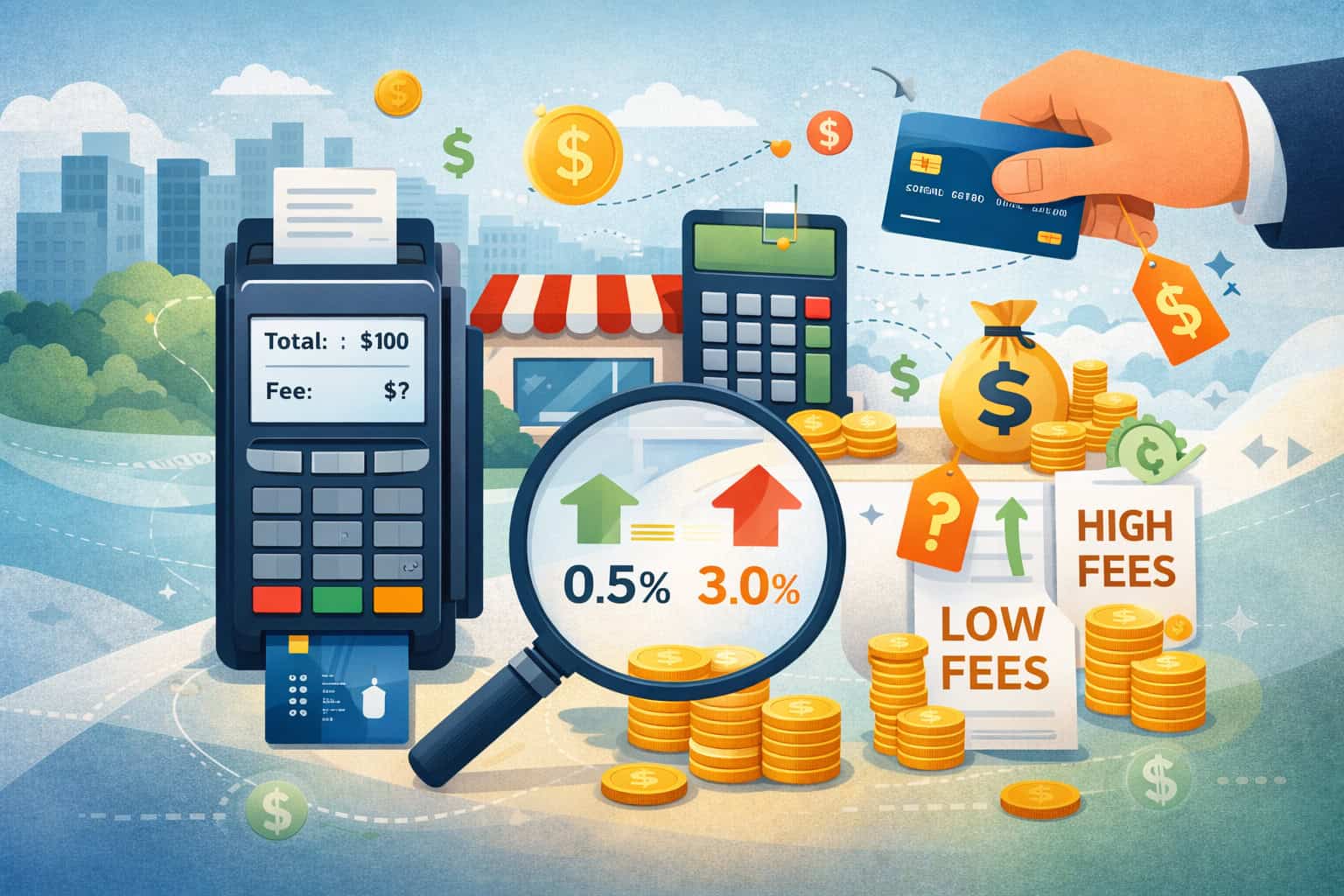
If you search for the “cheapest card transaction fees,” you’ll quickly see ads promising unbelievably low rates—sometimes “0% processing” or “1.29% flat.”
In real life, the cheapest card transaction fees are constrained by a few costs you can’t negotiate away: interchange (set by issuers/network programs), network assessments, and the processor’s markup.
That’s why “cheap” isn’t just a number—it’s a strategy that matches your business model (ticket size, card-present vs. online, rewards-heavy customer base, refunds, and chargeback risk) to the right pricing plan and checkout setup.
A realistic expectation is this: you can often reduce card transaction fees meaningfully, but you rarely eliminate them. The best outcomes usually come from improving your “effective rate” (your total fees divided by total sales) rather than obsessing over a headline rate.
Two merchants can both be “paying 2.6%,” yet one is truly optimized and the other is bleeding money through non-qualified downgrades, surcharges, or expensive keyed transactions.
Also, “cheapest” depends on what you’re measuring. Are you trying to minimize cost per transaction on small tickets? Lower blended fees across all card types? Reduce monthly fixed costs? Avoid surprise downgrades?
The right answer changes based on whether you run a retail counter, a service business, subscription billing, delivery, or high-ticket invoices.
This guide breaks down what cheapest card transaction fees look like in the domestic market, what’s marketing fluff, and what you can actually do to pay less—without getting trapped in contracts, hidden fees, or compliance landmines.
What “Cheapest Card Transaction Fees” Really Means in Practice
When people ask for the cheapest card transaction fees, they usually mean one of three things: (1) the lowest percentage rate, (2) the lowest total monthly cost, or (3) the most predictable bill with the fewest surprises. Those are not always the same.
A processor can advertise a very low “rate” but recover margin through account fees, PCI programs, statement fees, “non-qualified” downgrades, batch fees, gateway fees, inflated interchange categories, or cancellation penalties. That’s why the “cheapest card transaction fees” you see on a landing page can turn into expensive card transaction fees when your first statement arrives.
In realistic terms, the floor for card transaction fees is set by underlying network and issuer costs. Networks publish rules and fee structures, and interchange varies by card type (debit vs. credit), rewards level, how the card is accepted (tap vs. keyed), and your business category.
Visa explains that merchant fees are influenced by interchange and rules across the ecosystem, not just a processor’s pricing. Mastercard similarly publishes interchange program tables that show many different rate categories based on the transaction and merchant attributes.
So the realistic meaning of “cheapest” is: the lowest achievable total cost for your transaction mix while keeping risk, compliance, and customer experience intact. If you run mostly debit transactions with PIN, you can often get close to the cheapest card transaction fees available for in-person payments.
If you run mostly online rewards credit cards, the cheapest card transaction fees will still be higher because the underlying interchange is higher.
The Three Layers That Make Up Card Transaction Fees

Card transaction fees are best understood as three stacked layers. Once you see the layers, it becomes obvious why “too-good-to-be-true” pricing exists—and how to compare offers fairly.
Interchange: The Base Cost You Usually Can’t Negotiate
Interchange is the amount that flows to the card issuer (the bank that issued the customer’s card), and it changes based on card type and how you accept the payment. It’s also the biggest reason the cheapest card transaction fees vary from business to business.
A regulated debit transaction can be dramatically cheaper than a premium rewards credit card transaction, even if the sale amount is identical.
For debit cards issued by large banks covered by Regulation II, the cap is set by rule: the Federal Reserve explains the interchange fee standard as $0.21 + 0.05% of the transaction value, plus a potential $0.01 fraud-prevention adjustment (if eligible).
That structure is why many merchants see very low cost on certain debit sales (especially for higher tickets), and it’s also why PIN debit and debit routing decisions matter so much.
On the credit side, interchange categories are set by network programs and can be quite granular. Mastercard publishes extensive program/rate tables for periods like 2025–2026, reflecting how rates depend on merchant category and transaction qualification.
The practical takeaway: you can’t talk about the cheapest card transaction fees without talking about your card mix (debit vs. credit, regulated vs. unregulated debit, rewards vs. basic).
Network Assessments and Pass-Through Fees
Beyond interchange, networks charge assessment and other pass-through fees. These are typically smaller than interchange but still meaningful at scale. The key is transparency: in a good pricing model, these are passed through at cost with clear line items, not padded or duplicated.
Network rules also impact qualification. For example, how you submit transactions (timing, data fields, AVS/CVV for online, EMV/tap for in-person) can change which interchange category applies—directly affecting your card transaction fees.
Visa’s small business fee and rules resources reinforce that the ecosystem includes rules and program requirements, not just a “rate.”
Processor Markup: The Part You Can Actually Negotiate
The processor’s markup is where you have real leverage. This is the part that can move the needle toward the cheapest card transaction fees for your business—especially if you have consistent volume, low chargeback risk, and clean processing.
Markup may include:
- A percentage plus a per-transaction fee
- Monthly platform or account fees
- Gateway fees (especially online)
- PCI program/admin fees
- Chargeback handling fees
- “Risk” surcharges for certain verticals
The cheapest card transaction fees come from minimizing markup and eliminating junk fees, not by pretending interchange doesn’t exist.
What Rates Are Realistic Today (And Why “1.29% Flat” Usually Isn’t)
The most realistic way to think about “today’s cheapest card transaction fees” is to separate headline rates from effective rates.
A headline rate is what’s advertised (“2.6% + 10¢” or “interchange + 0.20%”). Your effective rate is what you actually pay after all card transaction fees, pass-through fees, monthly fees, and downgrades are counted.
In many cases, the cheapest card transaction fees are achieved not by switching providers, but by fixing acceptance methods and billing errors that inflate effective rates.
There is also a structural reason cheap advertised rates exist: many providers use simplified bundles to make sales easy. Bundles aren’t always bad, but they often price for a worst-case or high-rewards mix.
If your customers mostly use premium rewards cards, bundles can be predictably expensive. If your customers mostly use debit, bundles can be overpriced compared to an interchange-plus model.
On the regulatory debit side, the Federal Reserve’s published cap structure under Regulation II explains why regulated debit can be especially cost-efficient (and why some merchants push debit routing strategies).
On the research side, the Federal Reserve Bank of Kansas City has published updates and datasets discussing interchange fees assessed to merchants, illustrating how interchange varies by card type, merchant category, and network structures.
These sources reinforce a realistic truth: the “lowest” possible rate depends heavily on what customers pay with and how you accept it.
So if someone claims “1.29% for everything,” ask: does that include premium rewards, card-not-present, AmEx, and keyed transactions? Does it exclude certain “qualified” conditions? Does it require high monthly minimums, long contracts, or leasing hardware?
In most cases, the cheapest card transaction fees are the result of transparent pass-through pricing plus a low markup—then operational optimization to keep transactions qualifying at the best possible categories.
Pricing Models Compared: Which One Delivers the Cheapest Card Transaction Fees?
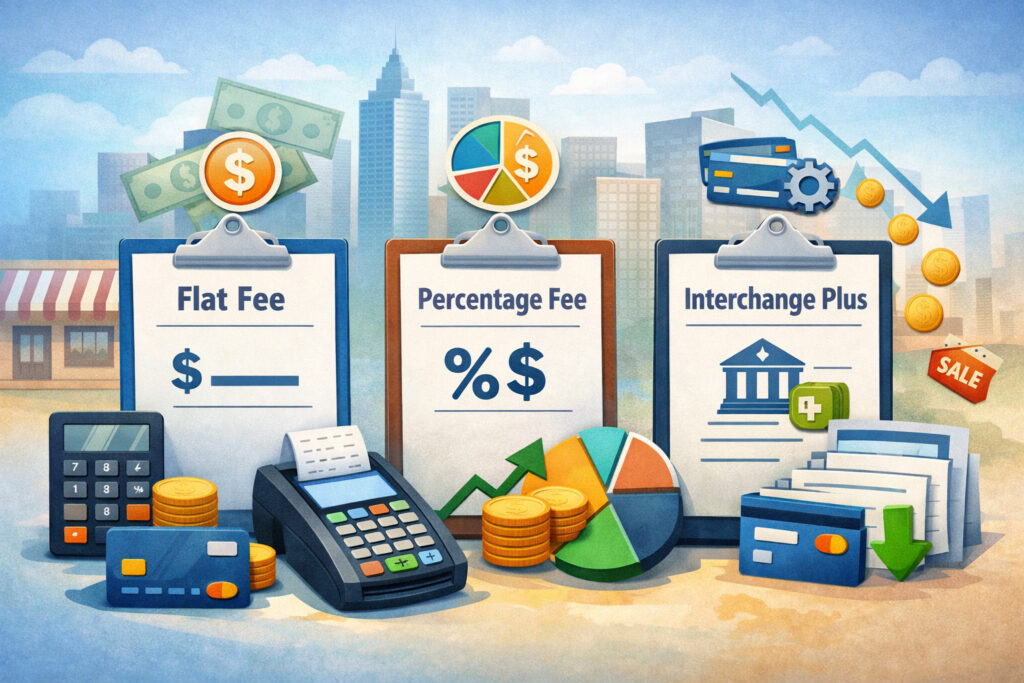
There are three dominant pricing structures in the market. Each can be “cheap,” but only one is consistently aligned with getting the cheapest card transaction fees for most established businesses.
Interchange-Plus Pricing: The Benchmark for Transparency
Interchange-plus (also called “cost-plus”) charges you the true interchange + network fees, then adds a fixed markup (like 0.20% + 8¢). This is often the cleanest path to the cheapest card transaction fees because it’s transparent: if interchange goes up, you can see it; if your card mix shifts toward rewards cards, you can see it; and the processor markup is easy to compare.
Interchange-plus also makes optimization measurable. If you improve your acceptance method (tap/EMV), reduce keyed entries, submit batches on time, or add proper data for certain transaction types, you should see improved qualification and lower card transaction fees.
Because networks publish extensive interchange program categories, the advantage of interchange-plus is that it doesn’t hide those categories inside vague “qualified/mid-qualified/non-qualified” buckets. Mastercard’s published 2025–2026 program tables are a good example of how nuanced categories can be.
Flat-Rate Pricing: Simple, Predictable, Not Always Cheapest
Flat-rate pricing is popular for new and small merchants because it’s easy to understand and stable month-to-month. But “simple” is not the same as “cheapest card transaction fees.” Flat rates bake in an average that often assumes a meaningful share of rewards credit and online risk.
If you’re mostly debit, flat rates can be expensive relative to the underlying debit cost structure. If you’re mostly online subscriptions, flat rates might be competitive because the bundle fits your risk/mix.
The realistic approach is: flat-rate is a convenience product. It can be “cheap enough,” but it’s not automatically the cheapest card transaction fees.
Tiered Pricing: Often Confusing, Sometimes Costly
Tiered pricing groups transactions into buckets like qualified/mid-qualified/non-qualified. The problem is you often can’t predict which bucket a transaction will fall into until after processing—and processors can define tiers in ways that maximize revenue.
Tiered pricing can still be workable in specific scenarios, but it is rarely the best route to the cheapest card transaction fees over time because it obscures the true underlying interchange and makes comparison shopping difficult.
If you’re serious about cheapest card transaction fees, your goal is to eliminate surprises and be able to audit your costs. Tiered pricing makes that harder.
The Biggest Drivers of High Card Transaction Fees (And How to Fix Them)
Getting the cheapest card transaction fees is less about negotiating a magic rate and more about removing “fee multipliers” in your operation. These are the patterns that push your costs up.
Card-Not-Present and Keyed Transactions Inflate Risk Costs
When you key in card numbers, take phone payments, or run online transactions, you increase fraud risk and reduce authentication strength. That usually triggers higher interchange categories and can increase chargeback exposure—raising card transaction fees and operational losses at the same time.
To push toward cheapest card transaction fees in these environments:
- Use tokenized payment links or hosted checkout pages instead of manual entry.
- Turn on AVS and CVV checks where appropriate (without blocking legitimate customers).
- Use 3-D Secure strategically for higher-risk segments.
- Store cards via vaulted tokens, not raw card data.
Even a small reduction in keyed transactions can make a noticeable difference in your effective rate.
Rewards Cards and Commercial Cards Cost More
Premium rewards cards often carry higher interchange. Commercial cards can also be expensive, especially if you can’t provide enhanced data (Level 2/3) to qualify for better programs on certain transaction types.
If your customer base skews toward rewards cards, the cheapest card transaction fees may require a combination of:
- Interchange-plus pricing (so you’re not paying a bundle premium on top of premium cards)
- Encouraging lower-cost payment methods in a compliant way (e.g., debit incentives, cash discounts, ACH for invoices where it fits)
- Optimizing data for B2B payments where applicable
Debit Routing and Regulatory Structures Matter
Debit can be your friend if you want the cheapest card transaction fees—especially regulated debit. The Federal Reserve’s Regulation II cap framework explains why certain debit transactions can be comparatively low-cost.
However, the debit landscape is also evolving. There has been policy discussion and feedback around potential changes to debit interchange cap rules and routing, which could affect future costs and incentives.
The realistic move is to stay flexible: use modern terminals, keep routing options compliant, and avoid locking yourself into proprietary systems that limit your ability to benefit from lower-cost debit paths.
Hidden Fees That Sabotage “Cheapest” Offers
Many businesses think they have cheap card transaction fees because the percentage looks low. Then they add up the rest of the statement.
Monthly Minimums, Statement Fees, PCI Programs, and “Admin” Charges
A low rate plus high fixed fees is a common tradeoff. If you process low volume, fixed fees can destroy your effective rate. If you process high volume, fixed fees matter less, but junk fees are still unnecessary overhead.
Look for:
- PCI “non-compliance” fees that feel punitive rather than helpful
- Bundled gateway fees that scale badly
- Separate “network access” fees that seem inflated
- IRS-style “regulatory product” add-ons that don’t add value
If the goal is cheapest card transaction fees, you want minimal fixed fees and clear pass-through costs.
Long Contracts, Liquidated Damages, and Equipment Leases
An offer can look like the cheapest card transaction fees—until you try to leave. Long-term leases for terminals are particularly expensive over the life of the agreement. Buying hardware outright or using fair monthly rentals is often cheaper.
A realistic approach:
- Prefer month-to-month processing agreements when possible.
- Avoid “liquidated damages” that charge the remaining contract value.
- Treat “free equipment” skeptically—it’s usually paid back through higher markup.
How to Negotiate the Cheapest Card Transaction Fees (Without Getting Burned)
If you want the cheapest card transaction fees, negotiation works best when you negotiate the right items, in the right order.
Step 1: Negotiate the Markup, Not Interchange
Interchange is largely non-negotiable. Your processor’s markup is negotiable. Ask for:
- Interchange-plus pricing
- A specific markup (percentage + per-transaction)
- A clear list of monthly fees (and removal of anything unnecessary)
Because networks publish and update program structures, transparency matters. Visa’s resources emphasize that merchant fees connect to rules and program structures; you want your processor to treat those as pass-through, not a profit center.
Step 2: Demand Statement Clarity and Pass-Through Proof
Cheapest card transaction fees require auditability. Ask for:
- Sample statements
- Explanation of pass-through fees (assessments, network fees)
- Confirmation that you can see interchange categories (especially if you’re B2B or debit-heavy)
Step 3: Match Pricing to Your Ticket Size
If you have small tickets (coffee shop, quick service), per-transaction fees matter more than percentages. If you have large tickets (contractors, high-value retail), percentage markup matters more.
A realistic negotiation aligns pricing with your average ticket:
- Small ticket: lower per-item fee can save more than shaving 0.05%
- Large ticket: percentage reductions and debit optimization can be huge
Operational Tweaks That Lower Card Transaction Fees Fast
The cheapest card transaction fees often come from operational wins that cost little or nothing.
Upgrade Acceptance: Tap/Chip Over Swipe, Avoid Keyed When Possible
Modern terminals and wallets can reduce fraud and improve qualification. Using EMV and contactless helps reduce certain risk signals. While it doesn’t magically change interchange for every card, it often improves your overall cost profile and reduces chargebacks.
Batch Timing and Authorization Discipline
Late batching or re-authorizations can trigger downgrades or extra costs depending on the transaction type and rules. Build a routine:
- Close batches daily
- Avoid holding authorizations too long
- Use proper partial auth handling where supported
- Fix POS settings that default to “keyed” modes
Refund and Chargeback Management
Refunds don’t always return all fees, and chargebacks add direct fees plus loss risk. Tightening policies and proof-of-delivery procedures can lower total payment cost, not just the processing rate.
Surcharging, Cash Discount, Dual Pricing: What’s Realistic and What’s Risky
Many businesses chase “cheapest card transaction fees” through customer-facing pricing programs. These can work—but only when implemented carefully and within network rules and local laws.
A realistic framing:
- Cash discount reduces card acceptance cost by incentivizing cash
- Surcharging passes a fee to credit card customers (often restricted; debit is typically treated differently)
- Dual pricing shows different prices depending on payment method
The danger is sloppy execution: confusing signage, inconsistent receipts, or applying a surcharge to debit where not allowed can cause compliance issues and customer frustration.
Also, the broader payments environment is actively contested. For example, major merchants and networks have been involved in long-running disputes about interchange and rules, and recent reporting noted a proposed settlement announced on November 10, 2025, discussing interchange reductions over time and changes in merchant flexibility—pending court approval.
This matters because it signals continued pressure and potential rule changes. If you design your strategy around “today’s loophole,” you may have to rebuild it later.
So yes, pricing programs can reduce your net card transaction fees. But “realistic” means: do it transparently, train staff, and choose a processor that supports compliant workflows.
The Future of Card Transaction Fees: What May Change Next
Future predictions should be cautious, but there are clear forces shaping where cheapest card transaction fees might go over the next few years.
Network and Merchant Pressure Will Continue
Interchange and network rules remain a major cost center for merchants, and the topic keeps drawing legal, political, and regulatory attention. The reported merchant-network settlement discussions in late 2025 highlight that pressure is not going away.
Even if a specific agreement changes or is delayed, the underlying incentive remains: merchants want lower costs and more routing/acceptance flexibility; networks and issuers protect revenue and rewards economics.
Debit Interchange Rules Could Shift
Regulated debit is one of the strongest paths to cheapest card transaction fees today, and any adjustments to cap structures or routing frameworks would affect merchants.
Public discussion around proposed changes and commentary periods signals that debit policy is still in motion. The Federal Reserve continues to publish Regulation II resources and data, reflecting ongoing oversight.
Real-Time Payments and Account-to-Account Options Will Expand
As more consumers and businesses get comfortable with bank-based instant transfers and account-to-account tools, some payment flows (especially invoices and subscriptions) may migrate away from cards—reducing card transaction fees by reducing card usage.
Cards will remain dominant for many everyday purchases because of rewards and buyer protections, but merchants will likely see more blended payment stacks: card + instant transfer + wallet + pay-by-bank.
The realistic prediction: the cheapest card transaction fees will increasingly come from smart routing and payment method choice, not from hoping card interchange disappears.
FAQs
Q.1: What is the absolute cheapest way to accept card payments?
Answer: The absolute cheapest card transaction fees usually appear when your transactions are mostly regulated debit, card-present, and routed efficiently, because regulated debit has a capped structure.
The Federal Reserve explains the debit interchange fee standard for covered issuers as $0.21 plus 0.05% of the transaction value, plus a possible $0.01 fraud-prevention adjustment. For many ticket sizes, that math can be meaningfully lower than credit card interchange.
But “absolute cheapest” is not only about the debit rate. You also need a pricing plan that doesn’t erase those savings with high per-transaction markup, monthly fees, or gateway charges.
A common mistake is using a flat-rate bundle that charges a credit-like percentage on debit-heavy sales. If you’re serious about cheapest card transaction fees, you typically want interchange-plus pricing and low fixed fees.
Also, “cheapest” must be realistic about customer choice. You can’t force customers to stop using rewards credit cards without potentially hurting conversion. The best strategy is to optimize debit acceptance, reduce key-entered transactions, and consider offering alternative payment methods for invoices where it fits.
Q.2: Are “0% processing” and “free credit card processing” real?
Answer: They can be real in a narrow sense, but the cheapest card transaction fees don’t vanish—someone pays them. “0% processing” is usually a cash-discount or surcharge program where the customer pays an added amount on card transactions, and you receive the sticker price.
That can reduce your out-of-pocket card transaction fees, but it introduces customer experience risk and compliance complexity.
The realistic issues are: signage, receipts, consistent application, and rules around which transactions can be surcharged. If done poorly, it can trigger complaints, refunds, or lost sales that cost more than the fees you saved.
Also, if your pricing program is built on a specific interpretation of network rules, changes in enforcement or policy can force you to change the setup later.
So yes, it can reduce your net processing expense. But it’s not “free,” and it’s not automatically the cheapest card transaction fees once you factor in customer behavior, disputes, and operational friction.
Q.3: Is interchange-plus always the cheapest card transaction fees option?
Answer: Interchange-plus is often the most reliable path to the cheapest card transaction fees for established businesses because it’s transparent and negotiable on the markup. Mastercard and Visa publish complex program structures showing that interchange varies by transaction type, which is exactly why transparency matters.
However, interchange-plus isn’t automatically the cheapest in every case. If you have very low volume, a flat-rate provider with minimal monthly fees might produce a lower total monthly cost, even if the percentage is higher. If you’re a very small operation, predictability and simplicity can be “cheaper” in time and admin burden.
The realistic way to decide: compare effective rates over at least 2–3 months, including all fixed fees, refunds, chargebacks, and gateway costs. Interchange-plus usually wins when volume is steady and your processor markup is competitive.
Q.4: What should I do if my customers mostly use rewards cards?
Answer: If your customers mostly use rewards cards, your cheapest card transaction fees will still be higher than a debit-heavy business because rewards cards often come with higher interchange.
The practical move is to stop chasing mythical “low flat rates” and instead focus on lowering processor markup and preventing expensive downgrades.
Start with interchange-plus pricing so you’re not paying a padded bundle. Then optimize acceptance: use tap/EMV in person, avoid keyed entry, and ensure your online checkout captures strong verification signals.
If you do B2B transactions, ask about enhanced data options (Level 2/3) that can improve qualification for certain commercial card scenarios—when supported and applicable.
Finally, offer alternative payment methods where it makes sense: ACH or instant bank transfers for invoices, subscriptions, and larger payments, while keeping cards for convenience purchases.
That blended approach is often the most realistic route to “cheapest” outcomes when rewards cards dominate your mix.
Q.5: Could card transaction fees go down in the next few years?
Answer: They could, but the most realistic view is “mixed.” Some pressures push fees down (merchant lobbying, legal settlements, policy proposals, more competition), while others push them up (more rewards, more fraud risk, more digital commerce, new network programs).
Reporting in late 2025 described a proposed settlement between major networks and merchants that included interchange reductions over time—though it still required approval.
Separately, regulated debit policy discussions have included proposals that could alter debit interchange economics, which would affect merchants relying on debit for cheapest card transaction fees.
The practical prediction: the biggest savings will come less from a universal “fee drop” and more from merchants adopting smarter payment stacks—routing debit efficiently, using lower-cost bank payments for invoices, and tightening fraud controls to protect qualification and reduce chargebacks.
If you build your plan around flexibility, you can benefit from favorable changes and protect yourself from unfavorable ones.
Conclusion
The cheapest card transaction fees are realistic—but only when you define “cheapest” correctly and measure what you actually pay. You can’t negotiate away interchange and network rules, and you shouldn’t trust offers that pretend those costs don’t exist.
What you can do is choose transparent pricing (often interchange-plus), negotiate processor markup, eliminate junk fees, and optimize how transactions are accepted so you avoid costly downgrades.
In practical terms, the merchants who win on cheapest card transaction fees do three things consistently: they track effective rate monthly, they reduce high-risk acceptance methods (keyed and unmanaged online), and they align payment methods with use cases (cards for convenience, bank-based options for invoices and larger payments).
Regulatory structures like the debit interchange cap framework explain why debit can be especially cost-efficient in many scenarios. Meanwhile, ongoing disputes, settlements, and policy discussions suggest the ecosystem will keep evolving, so flexibility matters more than ever.